

Will Meta's Muse AI Conquer the Office, or Will Trust Issues Destroy It?
Meta is aggressively pushing its new Muse AI into the enterprise space, but decades of privacy baggage might stop corporate adoption dead in its tracks.
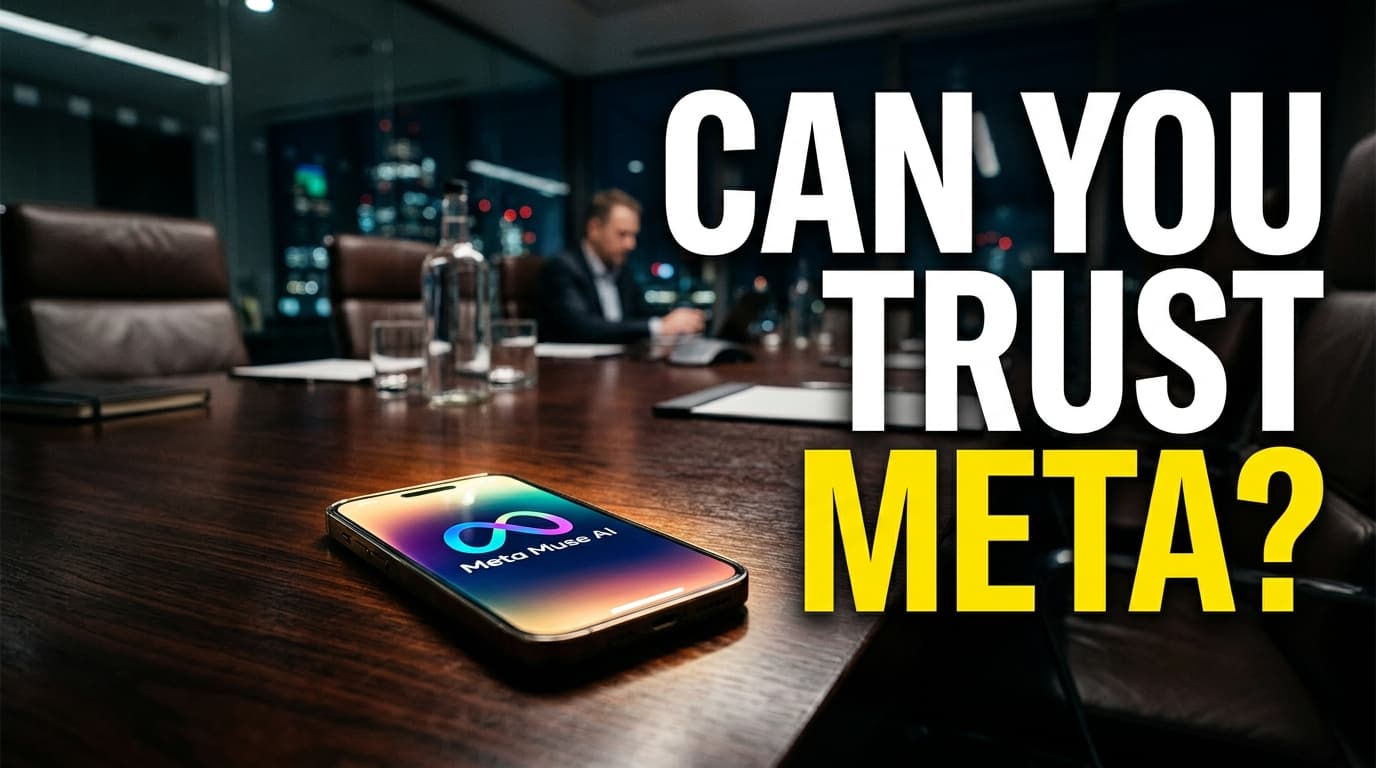
The battle for corporate artificial intelligence dominance has a fierce new contender, but it carries a mountain of historical baggage. Meta is aggressively pushing its new digital assistant into the workplace, pouring massive resources into ensuring the application becomes a daily habit for professionals across the globe. However, asking corporate clients to hand over their most sensitive internal data to Mark Zuckerberg's social media empire brings up serious, lingering questions about data privacy and corporate security.
Following a massive showing at the latest Meta Connect event, it is clear the company sees this new software as the connective tissue between its mobile apps and its rapidly expanding hardware ecosystem. Readers will discover exactly what Meta Muse AI brings to the table, how it integrates with the company's ubiquitous smart glasses, and whether the tech giant can finally shake its spotty data reputation to win over skeptical enterprise clients.
Key Takeaways
- Meta is making a massive enterprise push with its new AI agent, targeting corporate clients currently dominated by Microsoft and Google.
- Decades of consumer privacy controversies represent the single largest hurdle for Meta in convincing IT administrators to adopt its software.
- The recent Meta Connect event highlighted a deep integration between the new software and the company's heavily promoted smart glasses.
- To succeed, the company must prove it can effectively silo corporate data away from consumer training models.
- Industry analysts predict aggressive pricing strategies as Meta attempts to buy market share in the B2B sector.
The Meteoric Rise of Meta Muse AI
The artificial intelligence landscape of 2026 is brutally competitive, with tech giants fighting tooth and nail for every inch of screen time. Reports from late September indicate that Meta is putting immense financial and developmental muscle behind its new application as user adoption takes off. Unlike early chatbots that simply answered text prompts, this new application operates as a multimodal agent capable of seeing, hearing, and interacting with complex corporate environments. The company has realized that consumer dominance is no longer enough; the real revenue lies in recurring enterprise software subscriptions.
To capture this lucrative market, the application has been designed from the ground up to integrate with existing workflows. Meta is betting that its vast experience in building intuitive, highly engaging user interfaces will translate into a workplace tool that employees actually want to use, rather than one they are forced to use. The strategy relies heavily on user friction reduction. If an employee can draft a memo, query a database, and schedule a meeting with a single voice command, the productivity gains become impossible for executives to ignore.
However, breaking into the enterprise market requires more than just a slick interface. It requires a fundamental understanding of how businesses operate at scale. The current iteration of the software focuses on several core workplace competencies:
- Automated Data Synthesis: The ability to ingest thousands of pages of internal PDFs, financial spreadsheets, and meeting transcripts to generate concise, actionable executive summaries in seconds.
- Cross-Platform Communication: Native integration with popular messaging platforms like WhatsApp Business to handle customer inquiries and internal team coordination without switching applications.
- Visual Problem Solving: Utilizing advanced image recognition to analyze charts, graphs, and live video feeds to provide real-time strategic recommendations.
- Predictive Scheduling: Managing complex calendars across global time zones by analyzing the priority level of different projects and the historical availability of key stakeholders.
The Billion-Dollar Corporate Trust Barrier
Despite the impressive technical capabilities, the primary narrative surrounding the platform is one of deep skepticism. Financial analysts and tech journalists alike are asking the same critical question: Can the company overcome decades of trust baggage? When a chief information officer evaluates a new software vendor, they are not just looking at features. They are evaluating risk. Meta's history, a well-documented saga of consumer privacy missteps and regulatory fines, makes this a steep uphill battle.
In the consumer space, users often trade their personal data for free access to social networks. In the enterprise sector, that dynamic is completely inverted. Corporations pay premium subscription fees specifically to guarantee that their proprietary data remains locked down. If a pharmaceutical company uses an artificial intelligence agent to analyze clinical trial data, they need absolute, legally binding assurance that those findings will not accidentally leak into the public training data of a consumer-facing model.
To compete with established enterprise veterans like Microsoft and Google, Meta must undergo a massive cultural shift. It must prove that its enterprise division operates entirely separate from its advertising division. IT administrators demand rigorous compliance certifications, ironclad data processing agreements, and transparent audit trails. The specific hurdles the company faces include the following key areas:
- Data Siloing Guarantees: Providing verifiable proof that corporate prompts, uploaded files, and generated outputs are cryptographically isolated and never used to train the baseline foundational models.
- Regulatory Compliance: Achieving and maintaining strict adherence to global data protection frameworks like GDPR in Europe, HIPAA for healthcare clients in the United States, and SOC 2 Type II certifications for general data security.
- Granular Access Controls: Allowing network administrators to dictate exactly which employees can access specific features, ensuring that sensitive financial forecasting tools are restricted to authorized personnel.
- Indemnification Policies: Offering legal protection to corporate clients in the event that the artificial intelligence generates copyrighted material or hallucinated data that leads to a business loss.
Hardware Meets Software: The Smart Glasses Revolution
You cannot fully understand the company's enterprise strategy without looking at its hardware ambitions. At the recent Meta Connect event on September 26, the company's smart glasses were absolutely everywhere. The narrative shifted from virtual reality headsets designed for gaming to lightweight, stylish glasses designed for all-day wear. These glasses are the physical manifestation of the new digital assistant, serving as the ultimate frictionless interface for the modern worker.
Imagine a warehouse logistics manager walking the floor. Instead of carrying a clipboard or a tablet, they simply look at a pallet of goods. The smart glasses, powered by the new AI software, instantly recognize the barcodes, cross-reference the inventory database, and project the shipping destination onto the lenses. Or consider a field technician repairing complex industrial machinery. The glasses can stream a live feed of the broken component back to the central server, where the artificial intelligence overlays step-by-step repair schematics directly into the technician's field of view.
This hardware integration gives Meta a unique advantage over competitors who rely entirely on desktop or smartphone interfaces. However, it also compounds the trust issues. If employees are wearing internet-connected cameras and microphones on their faces all day, corporate espionage and accidental data leaks become a massive concern. A single employee wearing these glasses into a confidential board meeting or a secure research facility could inadvertently expose highly classified information.
Beating the Enterprise Giants at Their Own Game
Entering the B2B sector means going to war with companies that have dominated the space for decades. Microsoft has deeply embedded its Copilot technology into Windows and Office, creating an ecosystem that most corporations already pay for. Google has integrated Gemini deeply into Workspace, capitalizing on its dominance in cloud storage and email. Meta lacks a native desktop operating system and a traditional suite of office productivity applications. To win, it has to play a completely different game.
The strategy appears to be platform agnosticism combined with aggressive pricing. Reports suggest that Meta is willing to take significant initial losses to secure enterprise contracts, undercutting the established players to get a foot in the door. By offering an assistant that floats above the operating system, rather than being locked inside a specific word processor or spreadsheet application, the company hopes to appeal to businesses that use a fragmented mix of different software tools.
Furthermore, the company is leaning heavily into its dominance in global messaging. By turning WhatsApp Business into a primary conduit for Meta Muse AI interactions, it bypasses the need for a traditional email client. This is particularly effective in international markets where mobile-first communication has entirely replaced desktop-based workflows. The ultimate success of this strategy will depend entirely on whether the sheer utility of the tool can outweigh the inherent suspicion of the company providing it.
Summary
Meta is executing a highly aggressive push into the enterprise software market, banking on its powerful new artificial intelligence agent and a rapidly expanding ecosystem of smart glasses. While the technical capabilities of the platform are undeniably impressive, the company faces a monumental challenge in convincing corporate executives to trust it with highly sensitive internal data. If the tech giant can successfully prove its commitment to absolute data privacy and security, it could disrupt the entire workplace productivity sector. If it fails, the application will remain a powerful consumer novelty locked out of the lucrative corporate boardroom.
FAQs
What exactly is Meta Muse AI?
It is a highly advanced, multimodal artificial intelligence assistant designed by Meta to handle complex tasks, synthesize large amounts of data, and integrate deeply with both software applications and physical hardware like smart glasses.
Why are businesses hesitant to adopt it?
Many corporations are hesitant because Meta has a long, controversial history regarding consumer data privacy. IT administrators require absolute proof that their proprietary corporate data will not be used to train public models or be exposed to third parties.
How does the software integrate with Meta smart glasses?
The software acts as the brain for the hardware. The glasses use built-in cameras and microphones to feed real-time visual and audio data to the assistant, which then provides contextual information, translates languages, or answers queries via built-in speakers or visual overlays.
Is the enterprise version different from the consumer version?
Yes. The enterprise iteration is designed with strict data siloing, enhanced security protocols, and administrative controls that allow corporate IT departments to manage user access and ensure regulatory compliance.
When will the enterprise features be widely available?
Following the announcements at the late September Meta Connect event, the company is actively rolling out pilot programs to select corporate partners, with wider commercial availability expected in the coming months as they refine their security certifications.

Why Top AV Companies Are Suddenly Abandoning the 'Do-It-All' Self-Driving Dream
More in Tech
 Tech
TechWhy Autonomous Vehicle Companies Are Finally Giving Up on Trying to Do Everything
 Tech
TechMatt Mullenweg Survives Ouster Attempt as Automattic Installs Entirely New Board
 Tech
TechIs ChatGPT Dying? 5 Reasons OpenAI's Market Share is Crashing Before 2027
 Tech
Tech