

Why Autonomous Vehicle Companies Are Finally Giving Up on Trying to Do Everything
The self-driving dream is facing a major reality check. Companies are abandoning broad ambitions to focus on specific, profitable niches to survive the current market.
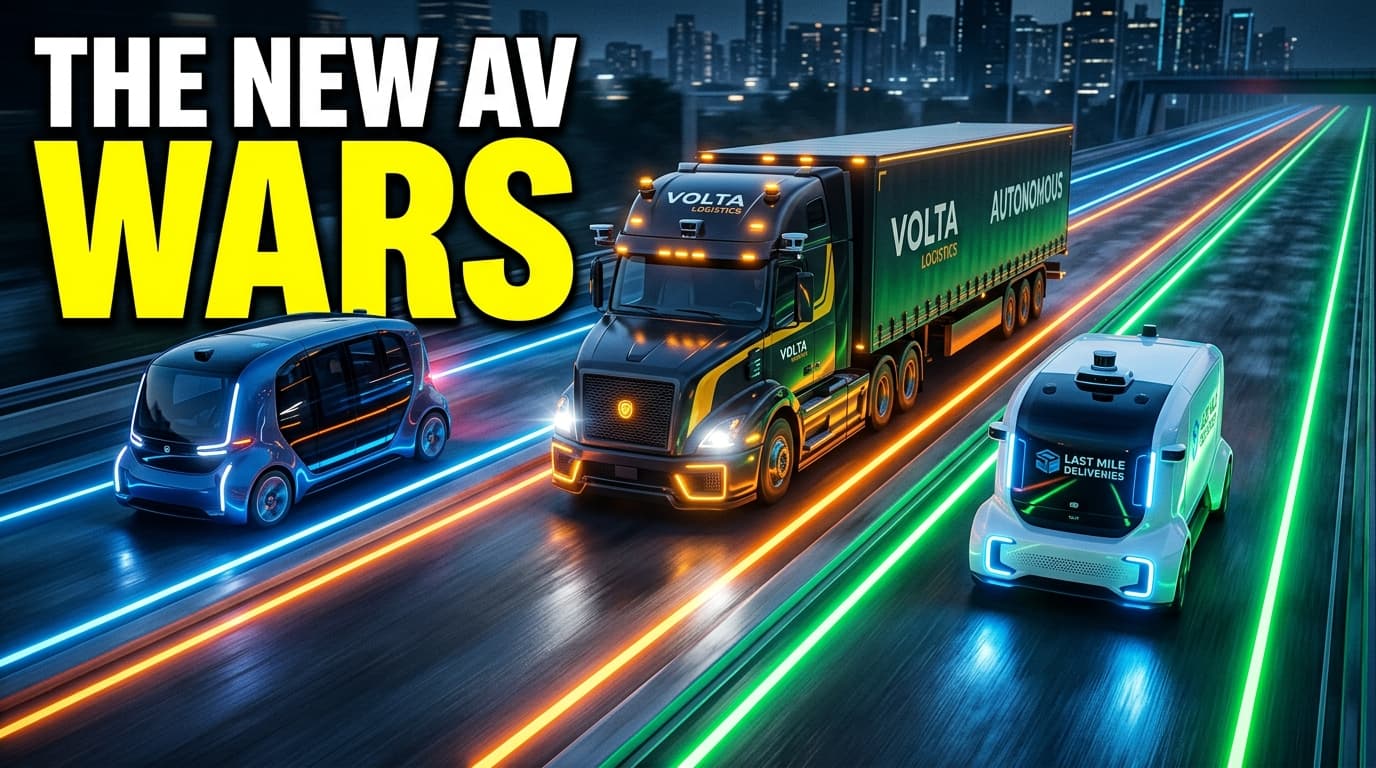
The era of the all-encompassing self-driving car company is officially over. As market pressures mount and venture capital grows increasingly scarce, autonomous vehicle companies are being forced to pick a specific lane or risk crashing out of the industry entirely. Gone are the days when a single tech startup could promise to revolutionize personal transit, long-haul trucking, and neighborhood grocery delivery all at once. Today, survival requires a razor-sharp focus on a single operational design domain. We are going to explore exactly how the biggest players in the mobility sector are shifting their strategies from total market domination to specialized niche operations to stay alive in 2026.
Key Takeaways
- Major autonomous vehicle companies are abandoning broad development strategies to focus on single, highly specific commercial use cases.
- Robotaxis and long-haul highway trucking have emerged as the two most viable, distinct paths for commercializing self-driving technology.
- Investor patience has worn thin across the tech sector, forcing startups to show a clear path to profitability rather than just flashing impressive prototypes.
- Last-mile delivery and specialized industrial autonomy are securing quiet but substantial funding rounds by avoiding the complexities of human passenger safety.
- Consumers will likely see self-driving tech integrated into commercial shipping and public transit networks long before personal autonomous cars become affordable or legal.
The Death of the Universal Self-Driving Dream
To understand the massive strategic pivot happening right now across the mobility sector, you have to look back at the original promises made a decade ago. In the early days, autonomous vehicle companies believed that solving the core problem of artificial intelligence driving would unlock every possible transportation market simultaneously. The prevailing theory was that once a computer could understand how to navigate a physical environment, porting that software from a small sedan to a massive eighteen-wheeler would be a trivial task. Industry leaders painted a picture of a unified future where a single underlying software architecture powered every vehicle on the road.
Reality hit the industry incredibly hard. The technical hurdles of generalizing driving behavior across vastly different environments proved nearly insurmountable for a single engineering team to tackle all at once. Engineers quickly discovered that the machine learning models required to navigate a slow-speed, highly chaotic urban intersection full of pedestrians are fundamentally different from the models needed to pilot a massive truck down a dark highway at seventy miles per hour. The sheer amount of data collection, edge-case testing, and sensor calibration required for just one of these environments is staggering. Trying to conquer both at the same time resulted in astronomical cash burns and severely delayed timelines.
By late 2026, the strategy has shifted entirely toward specialization. Industry giants and scrappy startups alike have looked at their balance sheets and made hard choices. The market has realized that mastering a geofenced urban environment does not automatically grant a company the ability to conquer interstate freight. Instead of building universal drivers, the industry is now building highly specialized tools designed to do exactly one job perfectly. This shift represents a maturation of the technology from a wild science experiment into a structured, realistic business model.
The Four Distinct Lanes of Modern Autonomy
As the industry fractures into specialized segments, four distinct lanes have emerged as the primary battlegrounds. Each requires a completely different approach to hardware, software, and regulatory compliance.
- Urban Passenger Transport (Robotaxis): Companies in this sector are entirely focused on replacing human rideshare drivers in dense city environments. The technical challenge here is massive due to unpredictable pedestrians, complex intersections, and tight spaces. These vehicles require incredibly dense sensor arrays and rely heavily on highly detailed, pre-mapped geographic fences.
- Long-Haul Freight Operations: This lane targets the massive logistics industry. By keeping autonomous trucks strictly on highways and moving them from transfer hub to transfer hub, developers avoid the chaos of city streets entirely. The focus is on long-range perception and predictive behavior at high speeds.
- Last-Mile Goods Delivery: These firms build small, slow-moving pods designed strictly to carry groceries, takeout, or packages. Removing the human passenger completely alters the safety requirements, drastically lowers manufacturing costs, and reduces the overall risk profile of the business.
- Consumer Software Supply (ADAS): Rather than attempting to build and manage a massive fleet of vehicles, some companies are acting as tier-one software suppliers. They develop advanced driver assistance systems and license them directly to traditional automakers for inclusion in consumer vehicles.
The Hardware Divide: Sensors and Speed
The decision to specialize is not just driven by software limitations; it is heavily dictated by physical hardware. The sensor suite required for a vehicle depends entirely on its operational domain, which forces autonomous vehicle companies to choose specific developmental paths. A robotaxi navigating the dense, chaotic streets of San Francisco or New York needs a 360-degree view with extreme detail at close ranges. These vehicles are draped in multiple LiDAR units, short-range radar, and high-definition cameras designed to spot a child stepping out from between parked cars or a cyclist running a red light. The hardware cost is immense, but the vehicle rarely exceeds forty miles per hour.
Conversely, a Class 8 semi-truck operating on an interstate highway has an entirely different set of physical requirements. A truck weighing eighty thousand pounds takes a massive amount of time and distance to come to a complete stop. Therefore, an autonomous trucking startup cannot rely on short-range, high-density sensors. Their hardware suites must be optimized for extreme long-range perception, often utilizing specialized forward-facing LiDAR and advanced optical cameras that can accurately identify stopped traffic or debris hundreds of meters down the road. The computing power is dedicated to predicting the behavior of other highway drivers over long distances rather than tracking dozens of pedestrians in a crosswalk.
Last-mile delivery vehicles require yet another completely different hardware approach. Because these vehicles operate at very low speeds and carry no human passengers, they can often rely on less expensive camera-based vision systems supplemented by basic ultrasonic sensors. If a delivery pod encounters an edge case it does not understand, its safest protocol is simply to stop moving entirely until a remote human operator can provide guidance. A robotaxi or a highway truck cannot simply hit the brakes in the middle of active traffic without causing a massive hazard. This fundamental difference in acceptable fail-states means that the hardware engineering teams for these distinct lanes cannot easily share resources or designs.
Follow the Money: Why Investors Demand Focus
Beyond the technical and hardware challenges, the primary catalyst forcing companies to pick their lanes is the current state of venture capital and corporate financing. During the peak hype cycle of the previous decade, money flowed freely into any startup with a compelling slide deck and a modified test vehicle. Investors were captivated by the total addressable market of replacing all human driving, a figure that easily stretched into the trillions of dollars. A startup could burn hundreds of millions of dollars annually while pursuing multiple vehicle platforms simultaneously, and investors would gladly write another check to keep the dream alive.
The financial climate of 2026 is vastly different. High interest rates, global economic uncertainty, and years of missed deadlines have entirely exhausted investor patience. The era of "growth at all costs" has been replaced by a ruthless demand for strong unit economics and a clear, near-term path to profitability. Institutional investors are no longer willing to fund massive science projects that lack a defined commercialization strategy. They want to see exactly how a company plans to generate revenue, lower its cost per mile, and scale a sustainable business.
By picking a single lane, autonomous vehicle companies can dramatically reduce their burn rates. Instead of maintaining separate engineering divisions for passenger cars and freight trucks, a company can pool all of its resources into solving one specific problem. This focus allows them to reach commercial viability in a single market much faster, proving their business model to wary investors before attempting to expand. In today's market, a company that masters autonomous highway trucking and turns a profit is infinitely more valuable than a company that is merely mediocre at both trucking and urban ridesharing.
The Regulatory Landscape Dictating Strategy
Navigating the complex web of local, state, and federal regulations is another major factor driving specialization within the industry. The legal frameworks governing transportation are highly fragmented, and different types of vehicles are overseen by entirely different regulatory bodies. A company attempting to build both a robotaxi and an autonomous semi-truck must fight legal battles on multiple fronts simultaneously, exhausting their legal teams and lobbying budgets.
For example, regulating commercial freight falls heavily under the jurisdiction of federal agencies like the Federal Motor Carrier Safety Administration (FMCSA) and state-level departments of transportation. The rules are focused on vehicle weight, interstate commerce, driver hours of service, and highway safety protocols. A company focused strictly on trucking can tailor its entire government relations strategy toward these specific agencies and the lawmakers who oversee them.
On the other hand, operating a robotaxi fleet in a major city involves a chaotic mix of municipal regulations, state-level public utility commissions, and local transit authorities. Urban operators must negotiate with city councils regarding curb space, accessibility standards for disabled passengers, and emergency responder interactions. The political friction is intense, as local residents and taxi unions frequently push back against autonomous testing in their neighborhoods. By focusing solely on this urban passenger lane, a company can dedicate its legal resources to winning over specific city governments one by one, rather than fighting a distracting nationwide battle over trucking regulations at the same time.
Summary
The maturation of autonomous vehicle companies from broad, overly ambitious tech startups into highly focused, specialized operators marks a critical turning point in the transportation industry. By accepting the technical limitations of artificial intelligence and respecting the intense financial demands of the current market, these firms are finally building sustainable business models. Whether they choose the complex urban environment of robotaxis or the high-speed logistics of highway freight, picking a specific lane is the only way these companies will survive to see their technology become a permanent part of our daily lives.
FAQs
What is an autonomous vehicle company?
An autonomous vehicle company is a technology firm or automotive manufacturer dedicated to developing the software, hardware, and operational infrastructure required to allow vehicles to drive themselves without human intervention.
Why are self-driving companies changing their business models?
Companies are narrowing their focus because developing generalized artificial intelligence for all driving conditions proved too expensive and technically complex. Investors now demand a clear path to profitability, forcing firms to focus on specific, viable niches.
Will I be able to buy a fully autonomous car soon?
Personal ownership of a fully autonomous Level 5 vehicle remains unlikely in the near future due to the immense cost of the required sensor hardware. Consumers are much more likely to experience the technology through commercial robotaxi fleets or public transit.
Which type of self-driving vehicle is closest to widespread commercial use?
Long-haul autonomous freight trucks operating on interstate highways and geofenced urban robotaxis are currently the two most advanced and commercially viable applications of the technology.
How much does autonomous driving software cost to develop?
Developing robust self-driving systems requires billions of dollars in research, development, real-world testing, and specialized engineering talent. This massive financial barrier is a primary reason why smaller companies are being forced to specialize or merge.
Do self-driving trucks use the same technology as robotaxis?
While the foundational machine learning concepts are similar, the physical hardware and predictive software models are vastly different. Trucks require long-range sensors for highway speeds, while robotaxis need highly detailed, short-range sensors for dense city streets.

Matt Mullenweg Survives Ouster Attempt as Automattic Installs Entirely New Board
More in Tech
 Tech
TechIs ChatGPT Dying? 5 Reasons OpenAI's Market Share is Crashing Before 2027
 Tech
TechFamily Outraged As Resellers Exploit 12-Year-Old's Death To Flip Pokémon Cards
 Tech
TechSay Goodbye to Wet Dog Smell: Levoit's New Air Purifier Conquers Apartment Pet Odors
 Tech
Tech