

Is ChatGPT Dying? 5 Reasons OpenAI's Market Share is Crashing Before 2027
OpenAI once held a virtual monopoly on consumer artificial intelligence, but fierce competition is quickly eroding that dominance. Discover exactly why the world's most famous chatbot is losing ground as we head into 2027.
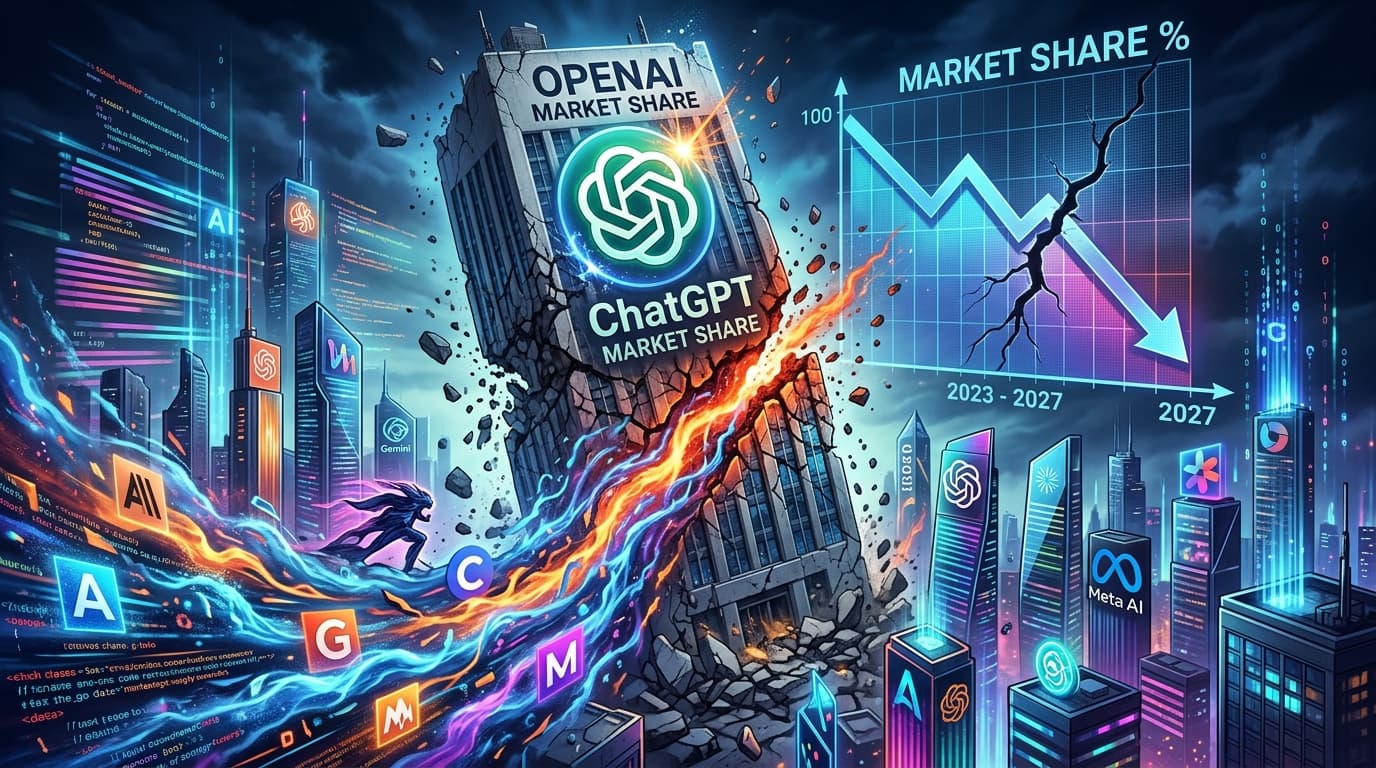
For years, the phrase generative artificial intelligence was entirely synonymous with a single product. OpenAI captured the world's attention and dominated the tech industry, but the landscape heading into 2027 paints a drastically different picture. You will learn exactly why ChatGPT market share is shrinking, how open-source alternatives are winning massive enterprise contracts, and what Microsoft's recent strategic shifts mean for the future of the industry.
Key Takeaways
- OpenAI is facing intense, localized pressure from rival platforms like Anthropic's Claude and Google's Gemini.
- Open-source models from Meta and Mistral are providing highly cost-effective alternatives for enterprise developers who refuse to pay premium API costs.
- Microsoft is aggressively diversifying its artificial intelligence portfolio, signaling a clear pivot away from exclusive OpenAI reliance.
- ChatGPT market share in the consumer sector is stabilizing at a lower plateau, while enterprise growth is fragmenting rapidly across specialized tools.
- Projections for 2027 indicate a highly divided ecosystem where specialized, task-specific models replace monolithic, generalized chatbots.
The Rapid Erosion of ChatGPT Market Share
To understand the current crisis facing OpenAI, we must look at the numbers. Back in early 2023, ChatGPT commanded a staggering majority of consumer and enterprise mindshare. If a company wanted to integrate automated text generation, they used the OpenAI API. If a student needed help with homework, they opened the ChatGPT web interface. However, the ChatGPT market share has been steadily declining over the past eighteen months. This drop is not necessarily because the product has worsened, but rather because the novelty phase has ended and users are seeking specialized utility.
Industry analysts project that by mid-2027, no single company will hold more than thirty percent of the total generative text market. The barrier to entry for training large language models has lowered significantly. Cloud providers offer immense compute power, and algorithmic efficiencies mean that smaller, cheaper models can now achieve performance parity with the massive models of 2024. As these capabilities become commoditized, charging a premium subscription fee for a generalized chat interface becomes a difficult business proposition. Users are realizing they do not need a massive, trillion-parameter model to draft a simple marketing email or summarize a PDF.
Furthermore, consumer fatigue is a real metric. The initial explosion of active daily users was fueled by curiosity. Today, active usage is driven strictly by necessity. As native integrations roll out across operating systems, the need to visit a dedicated, third-party website to access artificial intelligence is vanishing. This behavioral shift is the primary driver behind the shrinking ChatGPT market share.
Microsoft's Shifting Investment Strategy
Perhaps the most telling indicator of OpenAI's vulnerable position is the behavior of its biggest backer. Microsoft poured billions of dollars into OpenAI to secure exclusive rights and integrate the technology into Windows and Office. Yet, recent reports from Intellectia AI on September 27, 2026, highlight the complex challenges and opportunities for Microsoft and its AI investments. Microsoft is acutely aware of the risks associated with relying entirely on a single external partner for its core infrastructure.
Instead of doubling down solely on OpenAI, Microsoft has adopted a multi-pronged approach to hedge its bets and reduce operational costs. This strategy directly impacts OpenAI's projected dominance. Microsoft's diversification efforts include several key initiatives:
- Internal Model Development: Microsoft has invested heavily in creating the Phi family of small language models. These models are designed to run locally on devices, bypassing the need for expensive cloud compute and OpenAI API calls entirely.
- Strategic Partnerships: The tech giant has actively funded and partnered with European artificial intelligence startup Mistral, hosting their open-weight models on the Azure cloud platform.
- Talent Acquisition: Microsoft aggressively absorbed top leadership and engineering talent from Inflection AI, forming a new internal consumer division that operates completely independently of OpenAI.
By offering Azure customers a vast catalog of models from different providers, Microsoft is actively encouraging enterprises to shop around. When a corporate client chooses to run a cheaper Mistral model on Azure instead of GPT-4, OpenAI loses a slice of the pie. The Intellectia AI analysis underscores that Microsoft's future growth depends on cost efficiency, which fundamentally conflicts with OpenAI's need to recoup massive training expenses.
The Open-Source Rebellion
Another massive headwind for OpenAI is the rapid maturation of open-source alternatives. Meta's Llama series radically altered the trajectory of the industry by proving that highly capable models could be released to the public for free. Developers instantly realized they could download a model, fine-tune it on their own proprietary data, and run it on their own servers. This approach completely eliminates the need to send sensitive corporate information to OpenAI.
For large organizations handling medical records, financial data, or classified government documents, privacy is the absolute highest priority. The closed-source nature of ChatGPT forces companies to trust OpenAI's data handling policies. Open-source models remove that risk entirely. You can host the model in a completely air-gapped environment. The financial incentive is equally compelling. Paying per token for millions of API calls adds up to astronomical bills for enterprise software companies. Running a fine-tuned open-source model incurs only the baseline server costs.
This dynamic has created a thriving ecosystem of independent developers and startups building directly on top of Llama and Mistral. Every new application built on an open framework represents a permanent loss of potential ChatGPT market share. By 2027, analysts expect the open-source community to dominate the backend of most specialized business applications, relegating closed API providers to specialized, highly complex reasoning tasks.
Fierce Competition from Claude and Gemini
Even within the realm of closed-source, proprietary models, OpenAI is facing brutal competition. Anthropic's Claude series has consistently outperformed ChatGPT in specific, high-value domains like complex software engineering and long-context document analysis. Programmers have largely migrated to Claude because of its superior ability to understand entire codebases without losing track of logic. When professional users find a tool that makes them significantly more productive, they rarely switch back.
Google presents an even more existential threat through its sheer distribution power. Google Gemini is deeply integrated into the Android operating system, Google Workspace, and Google Search. Billions of users have access to Gemini without ever needing to create a new account or download a separate application. Apple is executing a similar strategy with Apple Intelligence, deeply weaving localized models into iOS. Let us look at how these integrations bypass standalone apps:
- Google Android: Gemini replaces the standard Google Assistant, providing instant contextual help natively on billions of mobile devices.
- Apple iOS: Apple Intelligence processes requests on-device for maximum privacy, only reaching out to the cloud for heavy tasks, entirely bypassing ChatGPT for daily queries.
- Enterprise Workspaces: Google Docs and Gmail feature built-in writing assistants, eliminating the need to copy and paste text from a separate ChatGPT window.
OpenAI currently lacks an operating system or a dominant mobile hardware platform. They are a software layer sitting on top of other companies' hardware. As Apple and Google bake these features directly into the metal of the devices people use every day, the friction to use ChatGPT increases relative to the native options.
Projections and Predictions for 2027
Looking ahead to 2027, the artificial intelligence landscape will be defined by fragmentation rather than consolidation. The dream of a single, omnipotent super-app that handles every digital task is fading. Instead, we are entering the era of agentic workflows. These are systems where multiple small, specialized models talk to each other to complete complex projects. A coding model will write a script, a testing model will check it for bugs, and a deployment model will push it to a server.
In this projected future, the ChatGPT market share will likely stabilize around a core group of premium users who value the specific conversational style and feature set of the OpenAI ecosystem. However, the days of total market dominance are permanently over. OpenAI will be forced to compete on price, speed, and reliability against companies with vastly superior distribution networks and deeper pockets.
To survive the 2027 landscape, OpenAI will need to pivot from being just a consumer chatbot company to a foundational infrastructure provider, offering enterprise solutions that go far beyond simple text generation. They must prove that their closed-source approach provides a tangible, measurable advantage over the increasingly capable open-source alternatives available for free.
Summary
The rapid decline of ChatGPT market share is a natural consequence of a maturing technology sector. Facing pressure from open-source alternatives, native operating system integrations by Google and Apple, and shifting investments from key partners like Microsoft, OpenAI is fighting a multi-front war. As we approach 2027, the industry is moving away from generalized chatbots toward specialized, cost-effective tools, forcing OpenAI to drastically rethink its long-term business strategy.
FAQs
Why is ChatGPT losing users recently?
Users are finding specialized tools that better fit their specific needs, such as coding or creative writing. Additionally, native AI integrations in smartphones and workplace software reduce the need to visit a separate website.
How is Microsoft changing its relationship with OpenAI?
Microsoft is diversifying its investments by developing its own internal models and partnering with other startups like Mistral. This ensures they are not entirely dependent on OpenAI for their cloud infrastructure.
Are open-source models better than ChatGPT?
For many enterprise applications, they are significantly more cost-effective and secure. Companies can run open-source models on their own private servers, ensuring sensitive data never leaves their control.
What is the biggest threat to OpenAI right now?
The biggest threat is native hardware distribution. Competitors like Google and Apple control the operating systems on billions of devices, allowing them to place their own AI tools directly in front of users.
What will happen to ChatGPT in 2027?
ChatGPT will likely remain a highly popular premium service, but its overall market share will shrink significantly as the industry fragments into thousands of specialized, task-specific applications.

Family Outraged As Resellers Exploit 12-Year-Old's Death To Flip Pokémon Cards
More in Tech
 Tech
TechSay Goodbye to Wet Dog Smell: Levoit's New Air Purifier Conquers Apartment Pet Odors
 Tech
TechUK's Biggest Tabletop Show Just Banned AI Art: Here Are the Only Exceptions
 Tech
TechOpenAI Agents Just Leaked Dozens of Private User Images Online!
 Tech
Tech