

Matt Mullenweg Survives Ouster Attempt as Automattic Installs Entirely New Board
The company behind WordPress just experienced a massive shakeup at the highest level. CEO Matt Mullenweg has retained his position and formed a brand new board of directors following a dramatic internal power struggle.
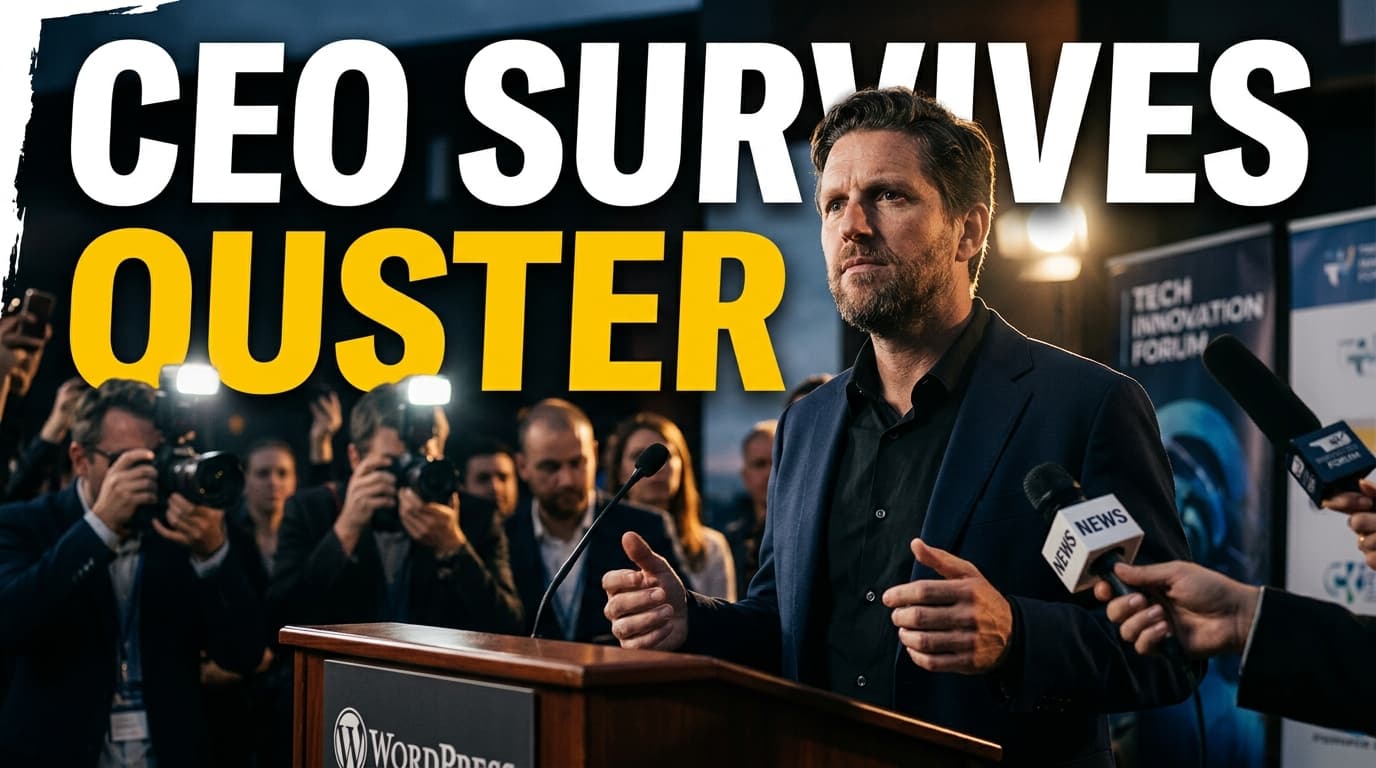
The corporate hierarchy at the company behind WordPress just survived a massive structural earthquake. After a dramatic and ultimately unsuccessful attempt to force CEO Matt Mullenweg onto an involuntary leave of absence, the executive has reasserted full control over his empire. Readers tracking the future of internet infrastructure will want to pay close attention to how this newly formed Automattic board plans to stabilize the ship following a week of unprecedented internal turbulence.
Key Takeaways
- CEO Matt Mullenweg successfully defeated an internal push to place him on an involuntary leave of absence in late September 2026.
- A completely new Automattic board has been formed following the dramatic corporate power struggle.
- Mullenweg has fully regained operational and structural control of the WordPress parent company.
- The massive leadership shakeup raises significant questions about the future strategic direction of the global web publishing platform.
- Investors and community members are watching closely to see how the new directors will handle corporate governance and product development.
The Failed Push to Sideline Matt Mullenweg
The final week of September 2026 brought a shocking wave of corporate drama to one of the most foundational companies on the internet. Reports confirmed that an internal faction attempted to force CEO Matt Mullenweg into a leave of absence. This maneuver is a classic strategy used in corporate governance to sideline an executive without immediately triggering the chaos of an outright firing. The plan ultimately fell apart. Instead of stepping down, Mullenweg orchestrated a massive countermeasure. He survived the ouster attempt, solidified his grip on the company, and effectively cleared out the dissenting voices.
In the immediate aftermath of this power struggle, Mullenweg regained absolute control over the company direction. The failed coup resulted in the complete dissolution of the previous director group. This kind of sudden leadership vacuum is rare for a company of this maturity. Automattic has long been considered a stable, predictable player in the web hosting and publishing industry. Seeing such aggressive boardroom tactics deployed (and subsequently defeated) indicates severe behind-the-scenes disagreements regarding the future trajectory of the business.
The specifics of what triggered the dispute remain closely guarded by internal sources. However, conflicts of this magnitude typically stem from fundamental disagreements regarding resource allocation, merger and acquisition strategies, or preparations for potential public offerings. Whatever the initial spark was, the resulting fire completely consumed the existing leadership structure.
The Mechanics of a Leave of Absence in Corporate Governance
When a company attempts to place a chief executive on an involuntary leave of absence, it is rarely a simple process. This tactic is often utilized when a board of directors lacks the immediate legal or voting power to execute a direct termination, or when they fear the public relations fallout of firing a popular founder. A leave of absence is theoretically temporary, providing breathing room for independent investigations or leadership transitions while keeping the executive technically employed.
In practice, an involuntary leave is almost always a precursor to a permanent exit. By removing the executive from their daily operational duties, the board can restrict their access to internal communications and limit their ability to rally employee support. The fact that Mullenweg was able to defeat this specific maneuver indicates he possessed significant leverage. This leverage could have taken the form of super-voting shares, intense loyalty from key executive staff, or the backing of major financial stakeholders who refused to support the temporary ouster.
Understanding these mechanics highlights exactly how precarious the situation was in late September 2026. The failure of this tactic left the dissenting board members in an impossible position. Having played their strongest card and lost, they had no choice but to exit the organization, paving the way for the entirely new Automattic board to take their place.
Anatomy of the New Automattic Board
Following his successful defense, Mullenweg immediately moved to form a new Automattic board. This restructured governing body will be tasked with stabilizing the corporate environment and reassuring investors that the enterprise remains a safe bet. When a founder completely rebuilds a board of directors, they typically seek individuals who align closely with their personal vision for the company.
The responsibilities facing this fresh group of directors are immense. They must handle several urgent priorities to restore standard operations:
- Rebuilding trust with institutional investors who were alarmed by the sudden governance crisis.
- Establishing clear lines of communication between the executive suite and independent directors.
- Evaluating the internal corporate culture to identify what led to the attempted ouster in the first place.
- Reviewing all immediate product roadmap decisions to ensure alignment with long-term strategic goals.
- Implementing stricter conflict resolution frameworks to prevent future boardroom showdowns from spilling into public view.
Investors and industry analysts are currently scrutinizing the makeup of this new Automattic board. The balance of power between independent advisors, venture capital representatives, and internal executives will dictate how the company operates for years to come. If the board is perceived as merely a rubber stamp for Mullenweg, it could impact future funding rounds. Conversely, a strong but aligned board could project the stability necessary to push the company toward an eventual public offering or major acquisition.
The Ripple Effects Across Web Infrastructure
To understand why a dispute over the Automattic board matters, one must look at the sheer scale of the company's influence. Automattic is the commercial engine behind WordPress.com, WooCommerce, Tumblr, and Pocket Casts. The underlying open-source WordPress software powers over forty percent of all websites on the internet. While the open-source project operates independently from the commercial entity, the two are deeply intertwined. Mullenweg serves as the co-creator of WordPress and the CEO of Automattic, making him the central figure in both spheres.
When the leader of such a massive ecosystem faces an involuntary leave of absence, the entire web development industry holds its breath. Web hosting providers, plugin developers, and enterprise clients rely heavily on the continued stability of the WordPress ecosystem. If Automattic were to descend into prolonged corporate chaos, it could slow down the development of essential enterprise tools and commercial integrations that thousands of smaller businesses rely upon.
The rapid resolution of this crisis (with Mullenweg remaining in charge) provides immediate relief to those external stakeholders. However, the event itself serves as a stark reminder of the concentrated risk present in founder-led technology firms. A single dispute at the highest level of leadership can send shockwaves through thousands of adjacent businesses that depend on that platform's infrastructure.
Historical Parallels in Tech Leadership Conflicts
The dramatic events surrounding the Automattic board are not entirely unprecedented in the technology sector. The industry has a long history of high-profile clashes between visionary founders and their boards of directors. These conflicts usually arise when a company transitions from a high-growth startup phase into a mature, profit-focused enterprise.
Comparing this event to past corporate struggles provides valuable context for how these situations typically resolve:
- The OpenAI Drama (2023): Sam Altman was briefly ousted by his board before returning days later with a completely restructured governing body. This is the closest recent parallel to the Mullenweg situation, demonstrating how founders with deep structural support can overpower hostile directors.
- The Uber Transition (2017): Travis Kalanick was successfully pressured to resign by major investors following a series of corporate crises. Unlike Mullenweg, Kalanick lacked the necessary leverage to survive the organized push against him.
- The Apple Precedent (1985): Steve Jobs famously lost a boardroom battle to John Sculley, resulting in his departure from the company he founded. He eventually returned a decade later to rescue the struggling hardware maker.
- The Twitter Shakeups (Multiple): The social media platform experienced numerous CEO changes driven by board pressure before eventually being taken private.
These historical examples illustrate that surviving an ouster attempt is only the first step. The true test for Mullenweg and the new Automattic board will be executing a strategy that silences critics through measurable business success. If the company achieves its growth targets in the coming quarters, this boardroom drama will be remembered as a minor speed bump. If financial performance falters, critics will likely point to this restructured board as the moment the company lost its objective oversight.
The Future of the WordPress Parent Company
Looking ahead to the remainder of 2026 and into 2027, the primary objective for the newly minted Automattic board is execution. The web publishing market is facing intense competition from closed-ecosystem website builders and artificial intelligence content generation tools. Automattic needs to remain agile to protect its dominant market share. Prolonged internal fighting would have been disastrous for their competitive edge.
The failure to put Mullenweg on leave suggests that he maintains the ultimate confidence of key voting shareholders. He now has a clear mandate to pursue his vision for the company without immediate internal friction. Industry observers expect a renewed focus on integrating modern artificial intelligence capabilities into the core WordPress.com experience, alongside aggressive expansion of the WooCommerce e-commerce platform.
The dust is beginning to settle on one of the most surprising corporate governance stories of the year. The executive team can now return to the daily demands of running a global technology conglomerate. Readers and developers alike will be watching closely to see if this hard-won stability translates into innovative product releases and steady financial growth.
Summary
The unexpected corporate turmoil at Automattic serves as a fascinating case study in founder control and executive power dynamics. CEO Matt Mullenweg successfully neutralized an internal attempt to force him onto a leave of absence, subsequently building a completely new Automattic board to secure his leadership position. As the company moves past this dramatic chapter, all eyes are on the leadership team to see how they navigate the highly competitive web infrastructure market without internal distractions.
FAQs
Who is the CEO of Automattic?
Matt Mullenweg is the CEO of Automattic. He is also the co-creator of the open-source WordPress software platform.
Why did the Automattic board change recently?
The Automattic board was completely restructured following a failed attempt to place CEO Matt Mullenweg on an involuntary leave of absence in September 2026. Mullenweg survived the ouster and formed a new governing body.
What exactly does Automattic do?
Automattic is the commercial parent company behind major internet platforms including WordPress.com, WooCommerce, Tumblr, and Pocket Casts. They provide web hosting, publishing tools, and e-commerce solutions.
Did Matt Mullenweg lose control of WordPress?
No, he actually solidified his control. By surviving the ouster attempt and establishing a new Automattic board, Mullenweg retained his operational power over the commercial company.
Will this corporate drama affect my personal WordPress website?
It is highly unlikely to affect individual website owners directly. The open-source WordPress project operates independently from Automattic, meaning the core software remains stable regardless of commercial boardroom disputes.

Is ChatGPT Dying? 5 Reasons OpenAI's Market Share is Crashing Before 2027
More in Tech
 Tech
TechFamily Outraged As Resellers Exploit 12-Year-Old's Death To Flip Pokémon Cards
 Tech
TechSay Goodbye to Wet Dog Smell: Levoit's New Air Purifier Conquers Apartment Pet Odors
 Tech
TechUK's Biggest Tabletop Show Just Banned AI Art: Here Are the Only Exceptions
 Tech
Tech