

Massive iPad 12 Leak: Apple Code Confirms A19 Chip and 8GB RAM for Next Budget Tablet!
Hidden firmware code reveals Apple's next entry-level tablet will feature the A19 processor and double the memory. This massive hardware leap guarantees support for advanced AI tools on the cheapest tier.
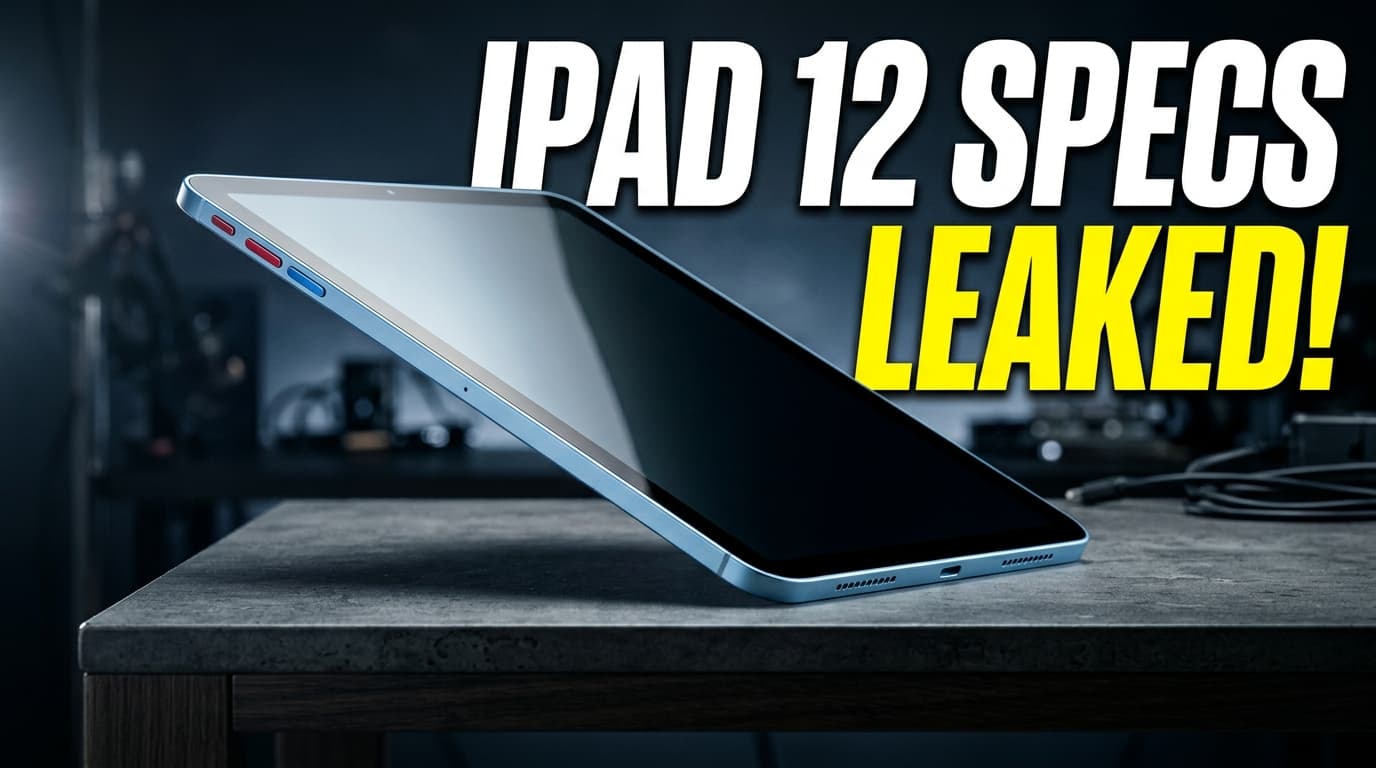
The era of hardware compromises on Apple's most affordable tablet is coming to a close. Hidden deep within recent firmware code, developers just uncovered the definitive specifications for the upcoming iPad 12, revealing a massive leap in processing power designed to handle complex machine learning tasks. If you have been holding out on upgrading your aging basic iPad, this monumental hardware refresh might finally provide the exact push you need to make a purchase.
Key Takeaways
- Recent Apple code snippets confirm the next-generation entry-level iPad 12 will feature the highly anticipated A19 processor.
- The device is getting a substantial memory bump to 8GB of RAM, completely doubling the capacity found in previous budget models.
- This specific hardware combination guarantees full support for the Apple Intelligence ecosystem on the company's cheapest tablet tier.
- Cellular versions of the new tablet will integrate the new proprietary C1X modem for improved wireless performance.
- Internal identifiers mark the device as the "N1" series, signaling a major architectural shift from the 10th-generation model.
The Heart of the Upgrade: A19 Silicon and 8GB RAM
For several consecutive years, the base iPad has functioned as the repository for Apple's older, recycled silicon. The 10th-generation model relied entirely on the aging A14 Bionic, a processor originally designed for the iPhone 12 series back in 2020. That strategy of using severely outdated chips is abruptly ending. Fresh code leaks from late September 2026 show the 12th-generation model leapfrogging past several chip generations directly to the A19 processor. This is the exact same silicon expected to power the mainline iPhone 18 series. Providing this chip represents an unprecedented level of parity between Apple's flagship smartphones and its cheapest tablet offering.
The inclusion of the A19 chip brings massive, immediate gains in both single-core and multi-core performance. Users will notice drastically reduced export times for video editing in applications like LumaFusion, alongside faster rendering for dense graphical layers in Procreate. The efficiency cores inside the A19 also promise to stretch battery life further than ever before, even under heavy computational loads. However, the upgraded processor is only half the story. The code leaks explicitly confirm the iPad 12 will ship with 8GB of unified memory. This represents a 100 percent increase over the minimal 4GB found in the previous iteration.
Why the sudden generosity with system memory? Apple's aggressive new software ambitions strictly demand it. The company's on-device machine learning models require a hard minimum of 8GB of memory to function properly without crashing the system. By equipping the base model with this much RAM, the tech giant is ensuring its budget buyers do not get left behind in the generative AI race. This vital memory bump will also dramatically improve basic daily multitasking. It will keep dozens of Safari tabs alive in the background longer and allow rapid switching between heavy applications without forcing them to reload from scratch.
Apple Intelligence Finally Hits the Entry Level
The most significant consequence of pairing the A19 chip with 8GB of RAM is the definitive arrival of Apple Intelligence on a budget-friendly device. Until now, these advanced computational features were strictly gated behind the M-series chips in the iPad Air and iPad Pro, or reserved for the A17 Pro and newer chips in the premium iPhone lineup. The iPad 12 is uniquely positioned to democratize these powerful tools for college students, casual home users, and public school districts.
Buyers can expect a comprehensive suite of powerful features natively integrated directly into the core operating system:
- Advanced Writing Tools: Native proofreading, professional tone adjustment, and rapid text summarization across all applications, including third-party word processors.
- Image Playground: The ability to generate custom illustrations, sketches, and digital paintings directly within Messages, Notes, and Freeform using simple text prompts.
- Genmoji Creation: Custom emoji generation based on user descriptions, allowing for highly personalized and expressive communication with friends and family.
- A Smarter Siri: The completely overhauled voice assistant with on-screen awareness, better contextual understanding, and the unique ability to string together complex, multi-step application requests.
- Notification Summaries: AI-driven categorization and summarization of messy lock screen notifications to significantly reduce digital clutter and distraction.
Bringing these advanced capabilities to the entry-level tier fundamentally changes the value proposition of the hardware. It transforms the basic tablet from a simple media consumption screen into a highly proactive digital assistant. Students can use it to instantly summarize long PDF research papers, while casual users can rely on it to draft perfectly toned emails to customer service departments.
Connectivity Boost: The C1X Modem and N1 Identifiers
While the processor and memory upgrades easily dominate the primary headlines, the leaked firmware code also sheds valuable light on Apple's broader supply chain strategy. The data reveals highly specific references to a "C1X" modem paired tightly with the internal device identifier "N1". This technical combination points heavily toward Apple finally integrating its own custom-designed 5G cellular modem into the mobile data variants of the iPad 12.
Apple has spent billions of dollars and several grueling years trying to break free from its total reliance on Qualcomm for cellular modems. Integrating their proprietary C1X chip into a high-volume, lower-stakes device like the base iPad makes perfect strategic sense for the engineering team. It allows the company to test the modem's real-world connectivity performance at a massive global scale before risking the technology on their crucial flagship Pro iPhones.
For the average end consumer, the custom modem could yield tangible, everyday benefits. Deep hardware integration between the A19 System-on-Chip and the proprietary C1X modem usually results in vastly superior battery life during cellular usage. We might also see improved thermal management when downloading large files over spotty 5G networks. This fixes a common pain point for road warriors, remote workers, and university students who frequently rely on cellular data outside the comfortable reach of stable campus Wi-Fi networks.
How It Compares to the iPad 10 and iPad Air
Understanding the sheer magnitude of this September 2026 leak requires directly comparing the upcoming iPad 12 against its immediate predecessor and its slightly more expensive sibling, the iPad Air. The traditional dividing lines separating Apple's distinct tablet tiers are about to blur significantly.
- Against the iPad 10: The older 10th-generation tablet features a severely outdated A14 Bionic chip, a meager 4GB of RAM, and zero hardware support for Apple Intelligence. The iPad 12's massive jump to the A19 and 8GB of RAM makes it exponentially faster and infinitely more capable for future iOS updates. The older model remains strictly a basic computing device, whereas the new version acts as a modern, AI-capable machine.
- Against the iPad Air: The current generation iPad Air relies heavily on M-series desktop-class silicon. While the M2 or M3 chips offer much higher memory bandwidth and faster sustained performance for intense professional applications like Logic Pro, the A19 in the iPad 12 will completely close the gap for standard everyday tasks. If both devices support Apple Intelligence and both feature 8GB of RAM, casual buyers will have very little practical reason to spend the extra premium money on the Air unless they specifically require Apple Pencil Pro support or a fully laminated display panel.
- Display and Design Constraints: The code leaks do not explicitly detail the upcoming display technology. However, strict industry analysts expect the iPad 12 to retain the exact same non-laminated 10.9-inch Liquid Retina display as the 10th generation to keep manufacturing costs down. It will also likely keep the popular landscape-oriented front-facing camera, which has thankfully become the standard orientation across the entire tablet lineup.
Release Window Expectations and Potential Pricing
The sudden discovery of this hardware code in late September 2026 strongly suggests the device is rapidly nearing its final testing phases. However, firmware references do not guarantee an immediate retail launch. Based on historical release patterns for the entry-level lineup, a massive architectural upgrade of this scale usually aligns with a dedicated spring press event or a quiet press release in the late fall. Readers should continually check for the latest official updates directly from Apple regarding exact retail availability and pre-order dates.
Pricing remains the single biggest variable surrounding this device. The 10th-generation model originally launched at an uncomfortably high premium price point before seeing necessary permanent discounts. Given the substantial manufacturing cost of the advanced A19 silicon, the denser 8GB RAM modules, and the potential inclusion of a custom 5G modem, Apple might struggle to hit the sub-$400 sweet spot. That specific price bracket is exactly what made previous entry-level models so incredibly popular within the education sector.
If the company can somehow maintain a starting price around $399 or $449, the iPad 12 will absolutely dominate the budget tablet market for years to come. It would offer unmatched performance-per-dollar, completely obliterating competing Android tablets in the exact same bracket that rely heavily on sluggish mid-range Snapdragon or MediaTek processors.
Summary
The leaked specifications for the iPad 12 paint a vivid picture of a device that completely redefines the technical baseline for Apple's entire tablet ecosystem. By bringing the highly advanced A19 chip and 8GB of RAM down to its most affordable tier, the company is actively ensuring that no user gets locked out of the ongoing Apple Intelligence revolution. This massive leap in raw processing power and memory capacity will likely make the upcoming entry-level tablet the absolute best value in consumer technology when it finally hits retail store shelves.
FAQs
Will the iPad 12 support Apple Intelligence?
Yes. The newly leaked firmware code explicitly confirms the inclusion of the A19 processor and 8GB of RAM. These specific hardware specifications easily meet the strict technical requirements for running Apple's suite of on-device artificial intelligence tools.
How much will the new entry-level tablet cost?
Official pricing has not been announced as of late September 2026. Industry watchers heavily expect the base model to launch somewhere between $399 and $449, depending entirely on the starting storage configurations Apple chooses to offer.
When does the iPad 12 actually come out?
While the firmware code strongly indicates the device is in advanced development stages, a firm release date is not yet confirmed. It is broadly expected to arrive either in late 2026 or early 2027 based on traditional hardware cycles.
Why is the RAM increasing to 8GB?
On-device machine learning and generative AI features require a massive amount of active system memory to function properly. Apple had to double the RAM from 4GB to 8GB just to make these advanced software features operate without slowing down the rest of the tablet.
Is the iPad 12 worth waiting for over the iPad 10?
Absolutely. The massive technical jump from the aging A14 chip directly to the A19, combined with double the system memory, represents one of the largest generational hardware leaps in the entire history of the entry-level iPad lineup.
Leaked Samples Prove the vivo X500 Pro Max is a Photography Monster
More in Mobiles
 Mobiles
Leaked Renders Reveal the Galaxy Tab S12 Ultra Is a 5.1mm Thin Beast with a 50MP Camera
 Mobiles
Vivo X500 Pro Max and Y600i: 7 Reasons They Just Broke the 2026 Smartphone Market
 Mobiles
Why Your New iPhone Battery Drains So Fast (And How to Fix It Today)
 Mobiles