

CERN Pulls the Plug: Why the Large Hadron Collider Is Officially Going Dark
Engineers have initiated the massive disconnection sequence for the world's most powerful particle accelerator. The multi-year shutdown sets the stage for a radical hardware transformation.
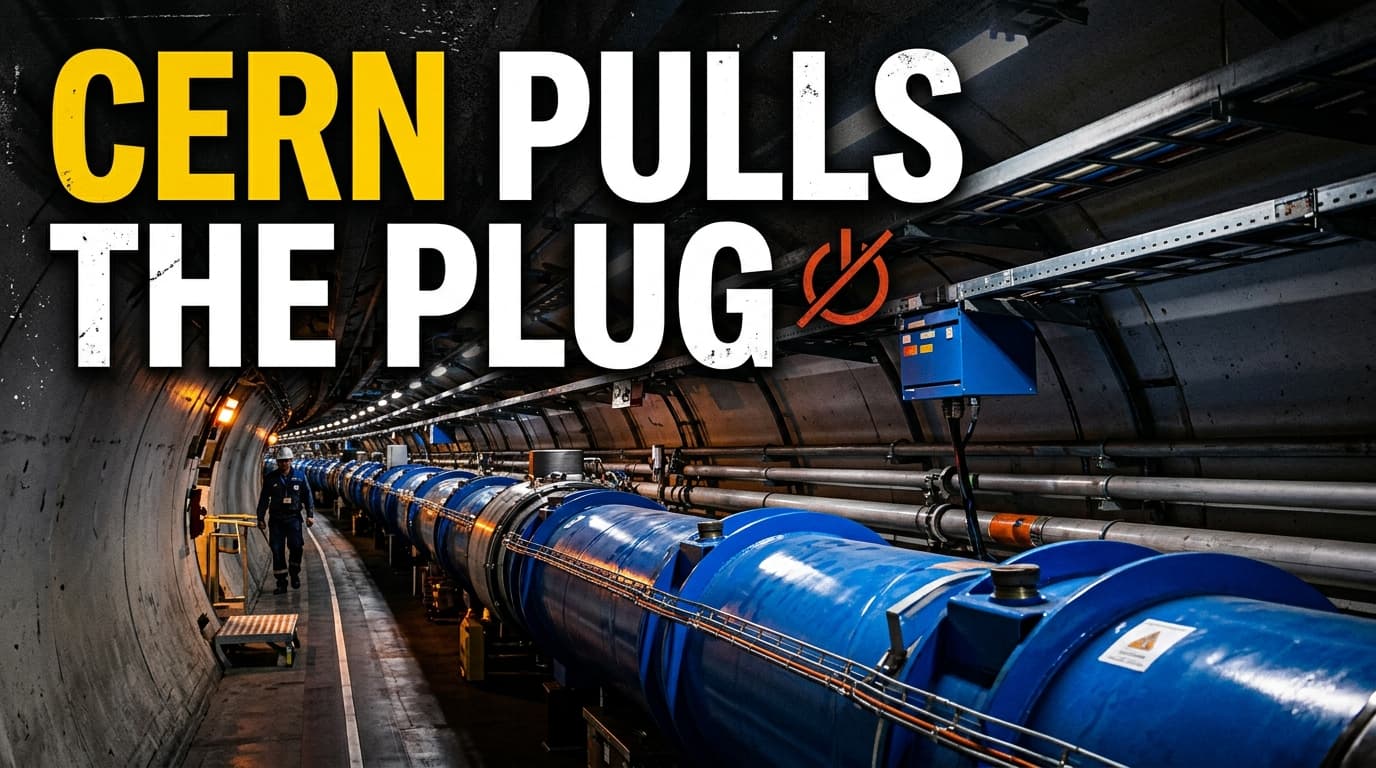
The European Organization for Nuclear Research has officially begun disconnecting the Large Hadron Collider. This monumental engineering operation marks the end of an era for the world's most powerful particle accelerator, setting the stage for a massive hardware transformation deep beneath the Swiss-French border. Readers will learn exactly why scientists are taking the machine offline, the staggering logistics involved in the cryogenic shutdown process, and what the next generation of particle physics research will look like once the dust settles.
Key Takeaways
- CERN initiated the massive disconnection sequence for the accelerator ring in late September 2026.
- The shutdown initiates the highly anticipated transition phase to the High-Luminosity configuration.
- Engineers must carefully warm up the 27-kilometer cryogenic ring before safely removing major superconducting magnets.
- The upcoming upgrades will increase collision rates by a massive factor, generating unprecedented amounts of experimental data.
- Physicists will spend the multi-year shutdown analyzing the massive backlog of data collected during the previous operational run.
Why CERN Is Powering Down Its Flagship Machine
The decision to power down the facility is not a sudden emergency or an unexpected failure. It represents a meticulously planned transition known as Long Shutdown 3. Since its initial startup, the facility has operated in distinct active runs separated by multi-year maintenance periods. Run 3 has just concluded, delivering an enormous dataset that researchers are only beginning to process fully. Now, the focus shifts entirely to the High-Luminosity Large Hadron Collider project.
By increasing the luminosity of the particle beams, scientists fundamentally increase the number of collisions occurring every second within the detectors. A higher collision rate means a higher probability of observing ultra-rare physical phenomena that currently remain hidden within statistical noise. The standard model of particle physics is incredibly accurate, yet it fails to explain dark matter, dark energy, or the stark imbalance between matter and antimatter in the observable universe. To find deviations from the standard model, researchers need exponentially more data than the current hardware can provide.
The existing infrastructure simply cannot handle the intense beam focusing required for this next leap in experimental physics. Replacing the inner workings of a 27-kilometer subterranean ring requires vast amounts of time and precise engineering. The current disconnection phase is the vital first step in this overhaul. Technicians must safely isolate various sectors, cut power to the massive electromagnets, and begin the delicate process of altering the beamline. This specific upgrade will fundamentally change how researchers search for supersymmetric particles and measure the deeper properties of the Higgs boson.
The Mind-Boggling Logistics of the Disconnection Process
Shutting down a machine that operates at temperatures colder than outer space requires extreme precision. Engineers cannot simply flip a switch to turn off the facility. The shutdown sequence is a complex choreography of thermal, vacuum, and electrical engineering. The accelerator tunnel sits approximately 100 meters underground, complicating every logistical step of the extraction and replacement process.
The primary steps of the disconnection phase include:
- Beam Dumping: Safely extracting the final high-energy proton beams and directing them into heavily shielded graphite absorption blocks to neutralize the energy.
- Electrical Ramping Down: Slowly decreasing the immense electrical currents flowing through the superconducting magnets to prevent sudden energy releases or dangerous thermal quenches.
- Cryogenic Warming: Gradually raising the temperature of the liquid helium cooling system from 1.9 Kelvin to standard room temperature. This single step takes weeks to execute safely.
- Vacuum Venting: Carefully breaking the ultra-high vacuum seals that normally keep the beam pipes emptier than interplanetary space.
- Sector Isolation: Placing physical barriers between different segments of the 27-kilometer tunnel to allow localized work.
- Component Extraction: Using specialized heavy-lifting equipment to transport massive dipole and quadrupole magnets out of the subterranean cavern for replacement or refurbishment.
Handling the cryogenic systems is perhaps the most delicate task of the entire operation. The facility holds roughly 130 metric tons of liquid helium. Warming the system too quickly could cause rapid expansion and catastrophic damage to the intricate piping. Every valve, sensor, and relief pipe must function perfectly during the thermal transition. Once the sectors reach room temperature, technicians can finally unbolt the massive interconnects that link the superconducting magnets together. Workers must also adhere strictly to radiation safety protocols, as residual radiation from beam operations requires careful monitoring before human crews can enter specific tunnel sectors.
What the High-Luminosity Upgrade Actually Changes
The primary goal of this multi-year shutdown is to install specialized equipment that will radically boost the machine's overall performance. The High-Luminosity upgrade is essentially a complete overhaul of the collision points where the major detectors, specifically ATLAS and CMS, sit. The sheer scale of the new hardware will force the engineering teams to expand the existing underground caverns.
Key hardware upgrades include:
- New Superconducting Quadrupole Magnets: Built using an advanced niobium-tin compound rather than the older niobium-titanium alloy. This brittle but powerful material allows the magnets to sustain much stronger magnetic fields, squeezing the proton beams tighter than ever before.
- Crab Cavities: Innovative radio-frequency devices that slightly tilt the particle bunches right before they collide. This rotation maximizes the physical overlap area of the beams, vastly increasing the collision probability.
- Upgraded Cryogenics: High-capacity cooling plants designed specifically to handle the increased heat load generated by the significantly more intense particle beams.
- Enhanced Detector Electronics: Complete replacements of the internal tracking systems for the major experiments. The new sensors must withstand much higher radiation levels and process raw data exponentially faster to avoid bottlenecks.
These modifications will allow the Large Hadron Collider to produce up to 15 million Higgs bosons per year. For context, the original discovery in 2012 relied on just a handful of clearly observed events. This massive increase in statistical power will allow physicists to measure the exact properties of fundamental particles with unprecedented precision. If entirely new physics exists just beyond our current theoretical models, this upgraded machine is the exact tool designed to find the evidence.
The Global Impact on Particle Physics Research
While the physical machine sits completely dormant, the global physics community will remain incredibly active. The current disconnection does not halt scientific research. Instead, it temporarily shifts the scientific focus from active data collection to intense computational analysis. The sheer volume of data generated during the previous operational years guarantees that discoveries will continue to emerge long after the physical hardware is powered down.
During Run 3, the detectors recorded petabytes of raw collision data. Thousands of researchers across the globe rely on the Worldwide LHC Computing Grid to download and analyze this immense backlog. This grid distributes the computational load across Tier 1 and Tier 2 data centers located in dozens of different countries. Scientists are currently writing new algorithms, training advanced machine learning models, and searching for subtle statistical anomalies in the existing dataset. The multi-year shutdown provides the necessary breathing room to fully digest the complicated results of the past few years of continuous operation.
The engineering teams are also using this exact timeframe to finalize structural designs for future projects. CERN is already evaluating the long-term feasibility of the Future Circular Collider, a massive proposed machine that would completely dwarf the current facility with a 100-kilometer ring. The specific lessons learned during the current disconnection and upgrade process will directly inform how engineers design the next generation of particle accelerators. Every technical challenge overcome during this specific shutdown builds the vital operational knowledge required for future scientific endeavors.
Summary
The disconnection of the world's largest particle accelerator marks a crucial transition point for modern physics. By taking the massive ring offline, engineers gain the access required to install the critical High-Luminosity upgrades needed to multiply collision rates and generate unprecedented experimental data. While the physical facility undergoes major renovations deep underground, researchers worldwide will spend the next several years analyzing a vast backlog of existing collision records, ensuring the pursuit of scientific discovery continues completely uninterrupted.
FAQs
Why is CERN shutting down the Large Hadron Collider?
Scientists are disconnecting the machine to begin a planned maintenance and upgrade phase known as Long Shutdown 3. This operational pause allows engineers to install the advanced High-Luminosity hardware required to drastically increase particle collision rates.
How long will the machine remain offline?
The shutdown sequence and subsequent upgrade process will take several years to complete fully. Current schedules project that the newly upgraded facility will resume active beam operations toward the end of the decade.
Will physicists stop working during the shutdown?
Absolutely not. Researchers will spend the entire shutdown period deeply analyzing the massive amounts of data collected during the previous operational run. Scientific papers and new findings will continue to be published regularly.
What is the High-Luminosity upgrade?
It is a major hardware overhaul involving stronger superconducting magnets and new beam-steering technology. The upgrade is designed to squeeze the particle beams tighter, providing more statistical data to help scientists find incredibly rare particles.
Is it dangerous to disconnect the accelerator?
The process involves managing extreme cryogenic temperatures and incredibly high electrical currents, requiring strict safety protocols. However, the engineering teams have successfully executed similar large-scale shutdowns multiple times in the past without incident.

Did Scientists Just Create Matter From Nothing? Quantum Computer Simulates The Impossible
More in Science
 Science
The Science Behind the GTA 6 Countdown: Why the Brain Obsesses Over It
 Science
Quantum Computing's Dark Horse Just Solved Its Biggest Flaw
 Science
This 'Rare' Autism-Linked Genetic Disorder Is Hiding in Thousands of Undiagnosed People
 Science