

Quantum Computing's Dark Horse Just Solved Its Biggest Flaw
Neutral atom systems just executed universal gate sets with unprecedented control, rattling IBM and Google in the race for practical quantum supremacy.
While tech giants spent billions welding superconducting circuits inside room-sized dilution refrigerators, an unassuming technology quietly matured in university basements. Physicists running neutral atom platforms have now demonstrated fault-tolerant universal logic gates, proving this once-overlooked architecture can execute any computational algorithm known to physics. The breakthrough shatters the long-held assumption that superconducting loops or trapped ions would monopolize the fault-tolerant era.
Key Takeaways
- Neutral atom processors use laser-trapped rubidium or cesium atoms suspended in vacuum chambers at room temperature.
- Researchers have successfully executed a complete set of universal quantum computing logic gates on neutral atoms, demonstrating both Clifford and non-Clifford operations.
- Unlike silicon chips that require custom microfabrication for every single qubit, neutral atoms are naturally identical, eliminating manufacturing defects entirely.
- Optical tweezer arrays can dynamically shuttle atoms in two and three dimensions during computation, a physical flexibility impossible on rigid circuit boards.
- Commercial timelines for practical, error-corrected hardware have suddenly compressed, placing startups directly alongside tech conglomerates like Google and IBM.
The Dark Horse Takes the Center Stage
For more than a decade, the quantum computing horse race seemed like a two-way duel between superconducting circuits and trapped ions. Silicon Valley heavyweights placed their bets on superconducting transmon qubits, building massive dilution refrigerators to cool metal loops to fractions of a degree above absolute zero. Trapped ion startups took the alternative route, using electromagnetic fields to pin charged atomic ions in linear chains. Both approaches hit stubborn engineering walls. Superconducting circuits suffer from cross-talk and fabrication variance; no two manufactured qubits behave identically. Trapped ions offer pristine physics, but scaling beyond a few dozen ions in a single trap triggers severe vibrational congestion.
Neutral atom systems emerged from an entirely different physics tradition. Rather than charging atoms or etching artificial circuits on silicon, researchers hold neutral, uncharged atoms (frequently rubidium-87, cesium-133, or ytterbium-171) in tightly focused beams of laser light known as optical tweezers. Because these atoms carry no electrical charge, they do not repel one another when packed closely together. For years, skeptics labeled the architecture an analog simulator: good for studying exotic magnetic materials or modeling condensed matter systems, but fundamentally incapable of executing arbitrary, universal algorithms. That critique is now officially dead.
Recent experiments led by teams at Harvard University, QuEra Computing, and the Massachusetts Institute of Technology flipped the narrative by demonstrating arbitrary multi-qubit gate operations alongside dynamic error-correcting codes. By driving atoms into highly excited Rydberg states, researchers can switch on powerful quantum entanglements in nanoseconds, perform precision rotations, and then return the atoms to ground state before decoherence destroys their phase. Achieving a full gate set verifies that neutral atom systems fulfill the DiVincenzo criteria, the standard checklist required for universal quantum computing.
Inside the Laser Trap: The Physics of Neutral Atoms
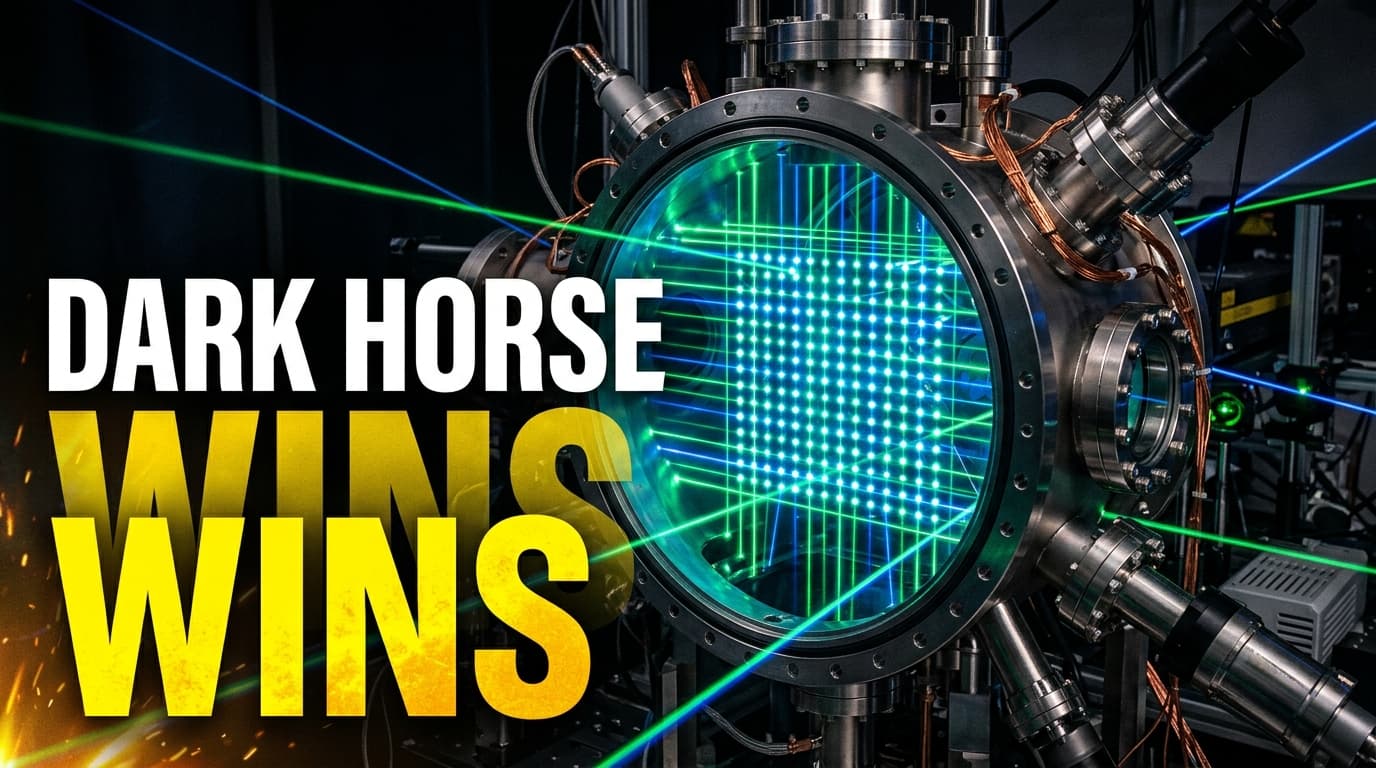
To grasp why this technical pivot matters, one must examine how neutral atom platforms manipulate matter. The processor does not exist on a fixed wafer inside a multi-million-dollar cryogenic vessel. The active zone sits inside an ultra-high vacuum glass cell kept at room temperature. Lasers crisscross this vacuum chamber, slowing drifting gaseous atoms down to microkelvin temperatures through Doppler cooling. Once cooled, spatial light modulators split laser beams into hundreds of individual optical traps, capturing single atoms like microscopic tractor beams.
The engineering advantages of this setup resolve several persistent manufacturing bottlenecks:
- Zero Fabrication Error: Every rubidium-87 atom in the universe shares the exact same mass, spin, and electronic transitions. There are no microscopic wire imperfections or lithographic misalignments.
- Dynamic Spatial Reconfiguration: Optical tweezers can physically move atoms while the quantum calculation is running. This shuttling allows non-local entanglements without running physical wires across the processor.
- Room-Temperature Vacuum Chambers: While the atoms themselves are cold, the surrounding hardware operates at standard room temperature, eliminating the need for massive liquid helium cooling systems.
- Extreme Qubit Density: Thousands of atoms can pack into an area smaller than a millimeter across, allowing massive physical qubit counts inside compact footprints.
When the computer needs two qubits to interact, laser pulses push the atoms into Rydberg states, causing the atoms' outer electrons to orbit tens of nanometers away from their nuclei. At this scale, the atoms swell to thousands of times their ordinary atomic radius. This artificial inflation creates the Rydberg blockade: if one atom enters the excited state, it shifts the energy levels of its neighbors, physically blocking them from exciting. This natural quantum gate enables two-qubit entangling operations with high fidelity, giving physicists the binary switch mechanism essential for building algorithmic routines.
Neutral Atoms vs. Superconductors and Trapped Ions
Evaluating this breakthrough requires comparing neutral atoms directly against the established front-runners. Until recently, superconducting processors held the record for raw qubit numbers, with systems reaching over one thousand noisy physical qubits. However, physical count means very little without fault tolerance. To correct errors, engineers must bind hundreds or thousands of noisy physical qubits together into a single, pristine logical qubit.
- Superconducting Qubits: Extremely fast gate operations (measured in nanoseconds), but plagued by short coherence times (under 100 microseconds), high fabrication defects, and rigid nearest-neighbor connectivity. Wiring thousands of coaxial cables down a dilution refrigerator poses an almost insurmountable plumbing challenge.
- Trapped Ion Systems: Outstanding gate fidelities and long coherence times (spanning seconds to hours). However, gate speeds are slow (microseconds to milliseconds), and physical scaling requires complex multi-core shuttle architectures that complicate laser alignment.
- Neutral Atom Systems: High coherence times (seconds in ground states), fast Rydberg gate operations, fully reconfigurable all-to-all connectivity via mobile tweezers, and effortless optical scaling to thousands of identical sites.
The recent demonstration proved that neutral atom architectures could not only perform arbitrary individual gates but could also implement transversal gates across encoded logical blocks. Transversal operations are the holy grail of error correction because they prevent physical errors from cascading out of control across the processor. In traditional fixed-geometry chips, running transversal logic between distant logical qubits demands labyrinthine swap operations that degrade fidelity. Neutral atoms solve this problem mechanically: the optical tweezers simply pick up the atoms representing one logical qubit, float them across the array, pair them next to their target group, execute the Rydberg pulse, and return them home.
The Road to Commercial Fault Tolerance
Proving that a hardware platform can achieve universal quantum computing on paper is one challenge; deploying it commercially is another. Industrial clients do not care about Rydberg blockades or tweezer wavelengths. They need processors that calculate complex molecular structures for drug discovery, optimize logistical supply networks, or crack intricate materials science problems where classical supercomputers stall.
The transition from experimental physics to enterprise-ready technology relies heavily on three ongoing engineering upgrades:
- Mid-Circuit Measurement and Reset: The ability to read out the quantum state of specific helper qubits without disturbing the surrounding data qubits. Recent experiments proved that using dual-species arrays (combining rubidium and cesium) allows lasers to measure one atom species completely transparently to the other.
- Laser Power and Phase Stability: Directing thousands of individual laser beams requires immense optical power and nanometer-accurate beam steering. Advances in commercial photonics and spatial light modulators are steadily solving these optical throughput limitations.
- Automated Trap Loading: Early neutral atom devices suffered from stochastic loading, meaning traps only had a 50 percent chance of catching an atom from the background vapor. Today, active sorting algorithms detect empty traps and rearrange filled tweezers in milliseconds, producing defect-free atomic grids before computation begins.
Because neutral atom setups avoid the extreme cryogenic refrigeration loads required by superconducting chips, their power draw and physical footprint remain surprisingly manageable. A neutral atom machine capable of supporting dozens of logical qubits can fit inside a standard enterprise data center rack, consuming a fraction of the electricity demanded by competing architectures. This thermodynamic efficiency alters the economics of high-performance quantum facilities.
Summary
Neutral atom architectures have officially graduated from specialized physics experiments into the premier tier of universal quantum computing. By executing arbitrary logical gate sets and demonstrating flexible error-correcting codes, laser-driven atomic arrays have eliminated the primary theoretical arguments raised by their detractors. The race toward commercially viable, fault-tolerant computation is no longer a closed contest between IBM and Google; the dark horse has caught up, rewriting the technological roadmap for the decade ahead.
FAQs
What makes neutral atom systems different from superconducting quantum computers?
Neutral atom systems hold identical, uncharged atoms suspended in vacuum using laser beams, whereas superconducting platforms use microscopic electrical circuits etched onto silicon chips chilled in dilution refrigerators. Neutral atoms eliminate manufacturing defects and allow flexible physical rearrangement of qubits during processing.
What does universal quantum computing actually mean?
Universal quantum computing refers to a system's ability to run any valid quantum algorithm by combining a complete set of fundamental logic operations, known as a universal gate set. Platforms lacking universality are limited to simulating specific physical phenomena or running narrow optimization routines.
Why are Rydberg states important for neutral atom qubits?
Rydberg states occur when lasers excite an atom's electron far from its nucleus, inflating the atom's size and generating strong electrical interactions. This temporary interaction triggers the Rydberg blockade, which physicists use as a high-speed switch to entangle neighboring qubits.
Do neutral atom quantum computers need liquid helium cooling?
No, the vacuum chamber and control electronics operate at standard room temperatures. The individual atoms are cooled directly using targeted laser light rather than massive, liquid-helium-fueled cryogenic dilution refrigerators.
When will neutral atom quantum computers become commercially useful?
Commercial hardware currently operates via cloud access for research and optimization tasks. Industry analysts project that error-corrected, fault-tolerant neutral atom systems capable of solving practical chemical and logistical problems will enter production between 2026 and 2028.