

A Uranus Moon Might Be Hiding an Ocean Deeper Than Anything on Earth
New research suggests Ariel, one of Uranus's moons, may harbor a subsurface ocean more than 100 miles deep beneath its cracked icy surface.
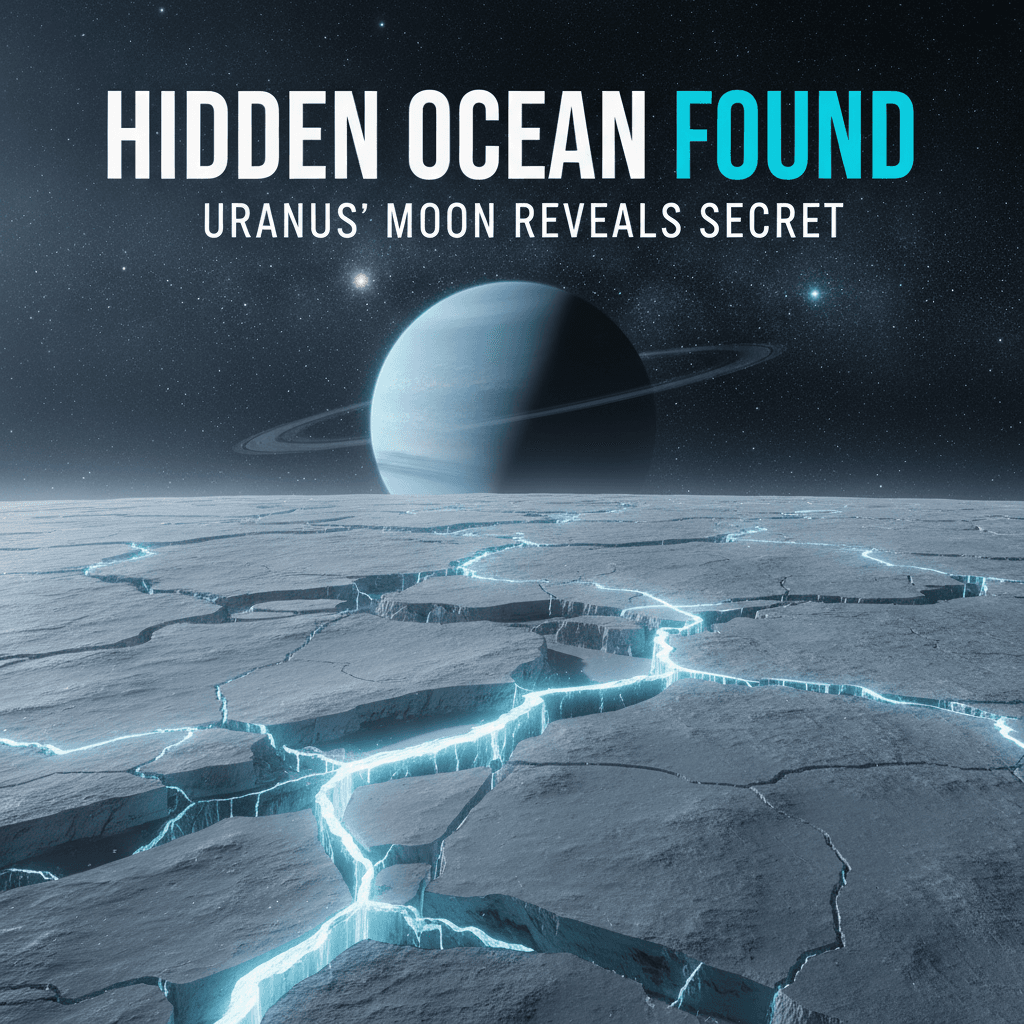
Uranus does not get much attention compared to Jupiter's or Saturn's moon systems, but new research on one of its smaller satellites might change that. Scientists studying Ariel, one of Uranus's five major moons, now believe it may be hiding a subsurface ocean more than 100 miles deep beneath its fractured, icy crust, based on patterns in the moon's surface geology first captured by Voyager 2 decades ago and reanalyzed with modern modeling techniques.
What Makes Scientists Think There's an Ocean Down There
Ariel's surface is covered in deep canyons and fault lines that look strikingly similar to features seen on other confirmed ocean worlds like Europa and Enceladus, moons where subsurface liquid water is essentially settled science. Researchers modeling Ariel's internal heat generation found that tidal forces from Uranus, combined with radioactive decay inside the moon, could plausibly keep water liquid far below the surface despite the moon's extreme distance from the sun and the correspondingly frigid surface temperatures.
The canyon networks in particular stood out. On Earth and on other icy moons, similar fracture patterns typically form when a rigid outer shell shifts or stretches over a liquid or slushy layer underneath. Ariel's canyons show the same telltale stretching signatures, which is what pushed researchers toward the subsurface ocean hypothesis rather than simpler explanations involving purely solid ice.
Why This Particular Moon Was Overlooked for So Long
Part of the reason Ariel has not been a bigger focus of ocean world research is simple: nothing has visited the Uranus system up close since Voyager 2's brief flyby in 1986. Every image and measurement scientists have of Ariel is decades old, captured during a single pass rather than the kind of sustained orbital study that missions like Cassini provided for Saturn's moons. That makes this new research almost entirely a reanalysis exercise, squeezing fresh insight out of old data using modeling techniques that simply did not exist in the 1980s.
Could This Change Plans for a Uranus Mission?
NASA and other space agencies have discussed a dedicated Uranus orbiter mission for years, partly because the ice giant and its moons remain the least explored major planetary system in the solar system. Findings like this one add weight to the argument that Uranus deserves a proper orbital mission rather than another flyby, since a subsurface ocean on Ariel would put it in the same conversation as Europa and Enceladus as a genuine target in the search for habitable environments beyond Earth.
No mission has been formally funded yet, and any Uranus orbiter would likely take well over a decade to design, build, and fly given the distances involved. Still, findings like Ariel's potential ocean tend to move the needle in these funding conversations, especially when they arrive alongside other recent surprises. Space observers have already had plenty to talk about this year, from newly discovered exoplanets with orbits that shouldn't exist according to current models to now a possible ocean hiding in plain sight since 1986.
For now, Ariel's ocean remains a strong hypothesis rather than a confirmed fact, but it is exactly the kind of finding that tends to reshape which targets get prioritized the next time a big planetary science mission gets greenlit.
What Makes Ariel Different From Uranus's Other Moons
Uranus has five major moons, Miranda, Ariel, Umbriel, Titania, and Oberon, and each shows a different level of geological activity in the handful of images Voyager 2 managed to capture. Ariel stood out even in 1986 for having the youngest looking surface of the group, with far fewer impact craters than Umbriel or Oberon, suggesting some process has been resurfacing it more recently than its neighbors. Scientists have debated for decades whether that resurfacing came from ancient volcanic activity, tidal heating, or something else entirely, and the new subsurface ocean modeling gives that debate a much more concrete answer than it has ever had before. If Ariel really does have a deep ocean, it would also raise fresh questions about Umbriel and Titania, which show some similar but fainter surface features that researchers have generally dismissed as less interesting simply because nobody had reason to look closely until now.