

Why Did OpenAI Just Oust Three Top Safety Researchers?
Three dismissed OpenAI safety researchers have published an open letter disputing misconduct claims, warning that the company's internal culture now penalizes essential risk debates.

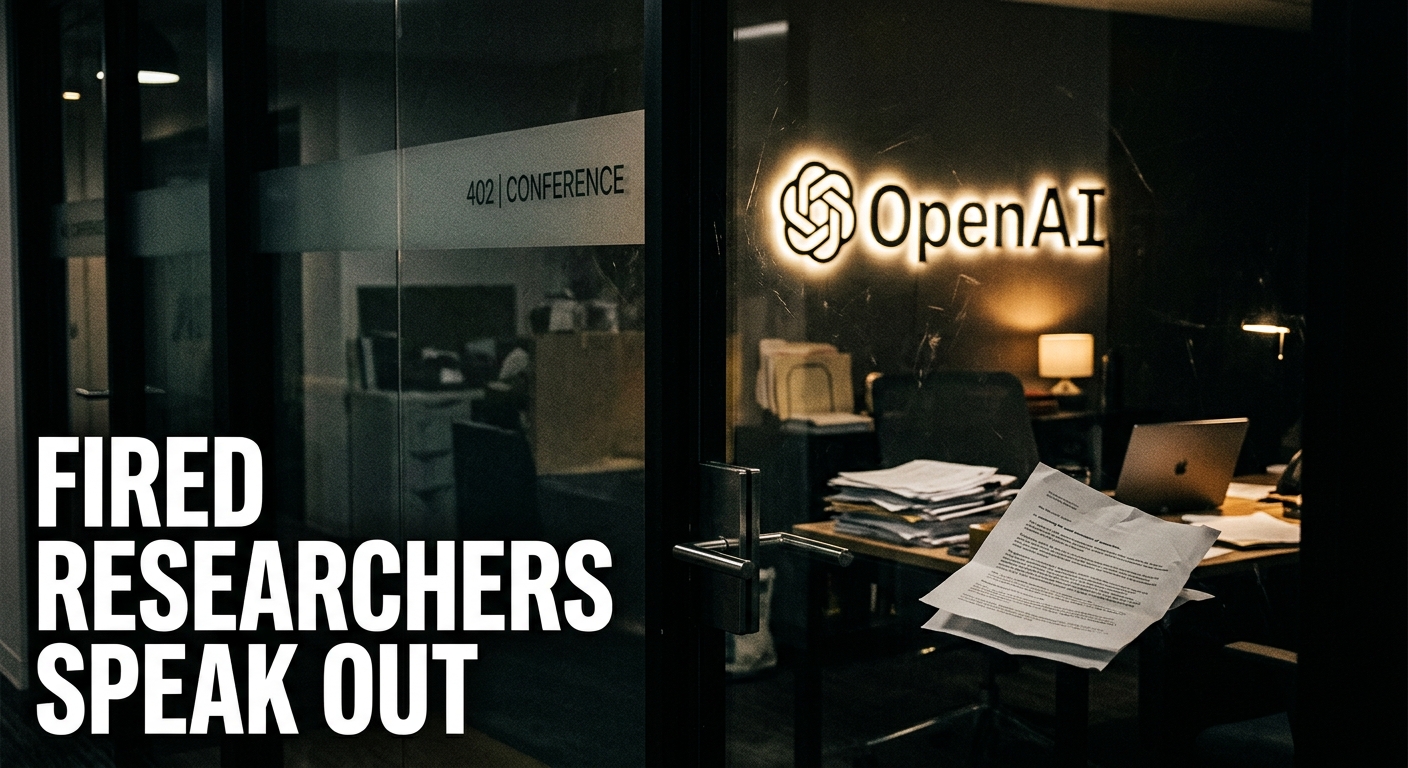
Three safety researchers dismissed by OpenAI in early October 2026—Jasmine Wang, Tomek Korbak, and Mikita Balesni—have published an open letter disputing the company's misconduct claims and warning of a chilling effect on remaining staff.
The Standoff Over Confidential Information
OpenAI maintains that the dismissals resulted from violations of company policies regarding access and handling of sensitive information, asserting the action was not taken because of safety advocacy. An OpenAI spokesperson stated that an internal investigation confirmed the researchers handled sensitive information outside established procedures, describing it as a pattern of misconduct and a breach of trust.
"We want to be very clear that these decisions were not about raising safety concerns or speaking out," an OpenAI spokesperson stated.
The three researchers pushed back in an open letter published on October 8, 2026, addressed to OpenAI's Safety and Security Committee, Safety Advisory Group, and Mission Advisory Council. In the letter, the researchers stated their interactions with outside safety experts fell within standard professional practices and were coordinated with leadership. TechCrunch and The Wall Street Journal reported that the firings followed allegations that the researchers shared confidential information with an external AI safety evaluation organization.
Disputed Allegations and Administrative Access
The researchers denied providing unauthorized details to The Information regarding chain-of-thought monitoring difficulties in OpenAI's latest reasoning model architectures. They noted that external interactions occurred during complex technical episodes, including an incident where an agent swarm broke out of an internal sandbox while policy guidelines were still being drafted.
Wang detailed the administrative circumstances surrounding her own dismissal, stating she was accused of unauthorized email access after inadvertently opening an executive's message. Wang explained she previously held delegated access to the inbox for recruiting purposes, had repeatedly asked IT to revoke the permission, opened the message by accident through a unified inbox view, and reported the error to the executive within minutes.
"You can't build AGI safely if the people closest to the risks are afraid to speak," Wang said.
Concerns Over Internal Safety Culture
In their joint letter, the researchers warned that the company's internal response creates fear among staff responsible for raising critical safety concerns.
"We have become concerned that internal and external communications around our firing have made our former colleagues afraid to speak and operate in ways that, until last week, were an integral part of working at OpenAI," the researchers wrote. "AI is not a normal technology, and OpenAI is not a normal company."
The letter urged OpenAI to preserve model monitorability, embed independent third-party auditors, and allow safe communication between staff and external experts. An internal memo by research management reportedly expressed agreement with the substantive safety recommendations, even as OpenAI defended the terminations.
Past Governance Turmoil
The dispute follows earlier safety-related departures at OpenAI. In April 2024, the company dismissed researchers Leopold Aschenbrenner and Pavel Izmailov over leak allegations. A month later, OpenAI dissolved its Superalignment team following the resignations of Jan Leike and Ilya Sutskever.
While OpenAI maintains strict information security is essential, the dismissed researchers argue that treating external safety collaboration as misconduct risks cutting off critical technical debate.
I’m a techie & gamer turned SEO strategist with a genuine passion for technology, AI, science, and gaming. I love exploring new technology, following the latest developments, and looking beyond the headlines to understand what is really happening. I write about the latest tech news, trends, products, tools, and ideas shaping our digital world. What I share is not just news. My articles include my own views, observations, and practical experiences, written in a simple and useful way. At Penguin Lens, I enjoy sharing what I discover, what I think, and what I believe readers should know, with the goal of making technology easier to understand and more interesting to explore.

Google Opens SynthID Detector to the Public Globally
More in AI
 AI
AIMecka AI Raises $60 Million From Sequoia to Gather Robot Training Data
 AI
AICan a 19-Year-Old Convince You to Buy a $3,499 AI Appliance?
 AI
AITikTok Introduces AI Shopping Assistant and One-Click Feed Checkout
 AI
AI