
NFL Upsets and College Football Drama: 5 Massive Shocks Rocking the Sports World
Week 3 NFL clashes and pivotal Week 4 college football rivalries are turning early season predictions upside down. Here is what you need to track right now.
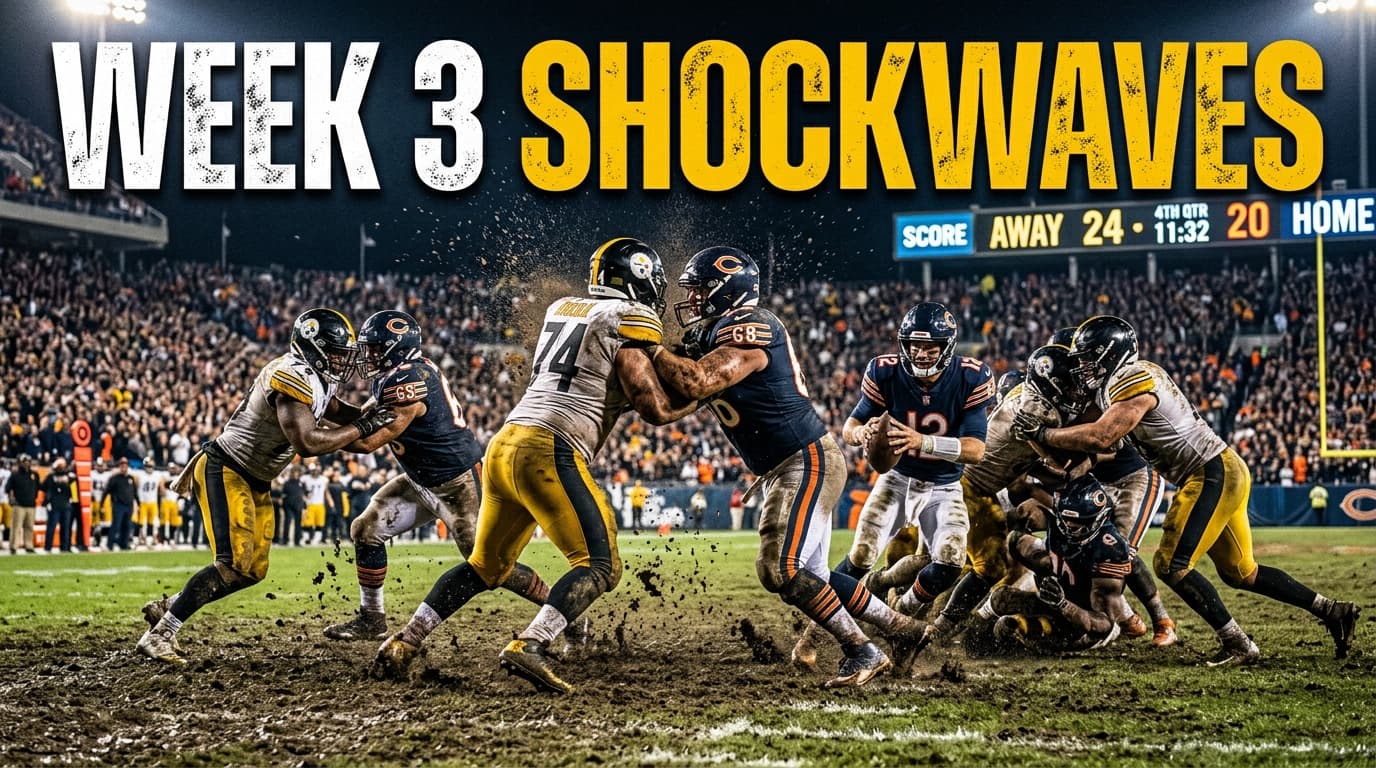
Late September has arrived with brutal collisions, unexpected upsets, and season-defining showdowns across both professional and collegiate gridirons. From desperate NFL franchises fighting to save their autumn campaigns to high-stakes conference battles reshaping the national rankings, the action has reached a fever pitch. Tracking the biggest storylines in sports this week reveals how thin the margin is between an early postseason push and an utter disaster.
Key Takeaways
- Carolina and Cleveland enter Week 3 under immense pressure, with quarterback play and offensive line health dictating their immediate futures.
- College Football Week 4 brings critical Big 12 matchups that threaten to fracture the expanded playoff picture before October even arrives.
- Vegas oddsmakers are seeing heavy public action on gritty underdogs, creating volatile betting spreads across pro football venues.
- Roster attrition is already biting contenders hard, forcing coaching staffs to adapt offensive schemes on short rest.
- Defensive consistency has emerged as the deciding factor separating dark-horse contenders from early-season pretenders.
NFL Week 3 Pressure Cookers: Panthers and Browns Clash in Desperation
Entering the third week of the professional football calendar, urgency shifts into outright panic for squads that stumbled out of the gate. The matchup between the Carolina Panthers and the Cleveland Browns embodies this reality. Both organizations entered late September trying to establish identity, yet both find themselves answering uncomfortable questions about their offensive execution and quarterback consistency.
For Carolina, the focus remains laser-focused on offensive rhythm and pocket management. After experiencing erratic starts in previous weeks, offensive coordinators must balance aggressive downfield shots with quick-release concepts designed to preserve protection schemes. When passing windows collapse in under 2.5 seconds, even the most detailed game scripts fall apart. Carolina's coaching staff has spent recent practices emphasizing quicker progression reads and heavier reliance on outside zone runs to slow down aggressive defensive fronts.
Cleveland presents an intimidating obstacle despite their own early hurdles. The Browns continue to rely on their punishing defensive front to dictate game script and mask offensive hiccups. Defensive line rotations in Cleveland are designed to exhaust opposing tackles through continuous pressure, racking up quarterback hurries and forcing hurried checkdowns. Here is how both clubs stack up across critical metrics entering this clash:
- Panthers offensive third-down conversion rate: hovering near 31 percent through early action.
- Browns defensive pressure percentage: ranking among the top eight in the league at 28.4 percent without blitzing.
- Carolina red-zone scoring efficiency: under 45 percent, illustrating severe finishing troubles inside the 20-yard line.
- Cleveland penalty yardage: averaging more than 65 penalty yards per contest, repeatedly stalling promising drives.
Whichever team establishes a foothold on early downs will control the tempo. If the Panthers fall behind early and become one-dimensional, Cleveland's pass rushers will feast. Conversely, if Carolina strings together methodical, ball-control drives that chew up clock, Cleveland's offense faces the dreaded scenario of playing from behind against a ball-hawking secondary.
College Football Week 4 Chaos: The Big 12 Scramble Intensifies
Campus football enters Week 4 with traditional expectations already scattered to the wind. Nowhere is this unpredictability more obvious than inside the expanded Big 12 Conference, where parity has replaced dominance. With legacy heavyweights gone to other leagues, every conference matchup now carries direct College Football Playoff implications, turning ordinary Saturday afternoons into tension-filled survival tests.
Several programs are discovering that traveling across multiple time zones strains depth charts far quicker than anticipated. Big 12 contenders are wrestling with rugged road environments where home underdogs routinely pull off late-game miracles. Coaching staffs must prepare for stark schematic contrasts: high-octane spread concepts on one sideline paired against methodical ground-and-pound ball control on the other.
A critical look at the biggest storylines in sports this week highlights how regional rivalries inside the Big 12 are creating absolute chaos for poll voters. Key factors defining this weekend's slate include:
- Quarterback mobility: Defensive coordinators are struggling to contain dual-threat signal callers who extend drives on third-and-long scrambles.
- Turnover margin volatility: Teams winning the turnover battle by two or more possessions in early conference play are sporting an overwhelming 88 percent win rate.
- Special teams blunders: Muffed punts and missed field goals from inside 40 yards have decided three major games already this month.
- Depth attrition: Programs lacking fourth-quarter defensive line rotations are surrendering an average of 11.2 points in final quarters alone.
National analysts monitoring the College Football Playoff race recognize that a single slip-up in late September can extinguish title hopes. For programs hoping to secure an automatic bid as a conference champion, dropping an early league matchup forces them onto a razor-thin tightrope for the remainder of the season.
Underdog Value: Why Sharp Bettors Are Fading Public Favorites
Sportsbooks across the nation are reporting significant divergence between casual bettors and seasoned syndicates as September winds down. Public money traditionally floods toward brand-name franchises and explosive offenses, driving point spreads beyond reasonable statistical projections. Savvy market operators have pounced on these inflated numbers, finding immense value on unfavored underdogs playing tight, low-possession football.
In Week 3 of the professional schedule, multiple underdogs catching field goal margins or more possess stylistic profiles suited to keep scores uncomfortably close. When oddsmakers post lines exceeding 4.5 points in conference or divisional rivalry games, historical data shows that home underdogs cover the number at an impressive clip over long sample sizes.
Several strategic elements make backing targeted underdogs appealing right now:
- Possession suppression: Underdogs leaning on downhill rushing attacks consistently reduce the total play count, limiting the favorite's offensive possessions to eight or nine per game.
- Red zone variance: Regression tends to punish early-season offenses that scored touchdowns on unsustainable percentages of red-zone trips.
- Weather adjustments: Early autumn weather patterns, including swirling winds and sudden rain, systematically favor running teams over perimeter-dependent passing units.
- Coaching conservatism: Heavy favorites often shift to defensive, clock-draining strategies once establishing modest two-score leads, leaving backdoor cover opportunities wide open.
Analyzing betting board movements reveals that sportsbooks are constantly adjusting limits to protect against sharp syndicates. As public sentiment continues to chase point-scoring juggernauts, disciplined observers find that tracking these underdog narratives provides genuine insight into how competitive parity truly functions across modern sports.
Tactical Chess Matches: Defensive Adjustments Taking Center Stage
While highlight reels inevitably showcase circus catches and deep touchdown throws, the true undercurrent shaping the biggest storylines in sports this week is defensive reinvention. Modern offenses spent the offseason perfecting lightning-fast perimeter screens and misdirection play-action designs. In response, defensive coordinators across both collegiate and professional ranks are unleashing sophisticated disguise packages to disrupt timing.
We are witnessing a widespread return to split-safety coverages designed to eliminate explosive plays through the air. Defensive backs are instructed to play top-down, daring offensive coordinators to call fifteen-play drives without making a single holding error or missed block. Teams lacking patience are turning the ball over at alarming rates because quarterbacks become frustrated by continuous two-high safety shells.
Furthermore, defensive fronts are relying less on traditional four-man rushes and more on simulated pressures. By showing eight defenders near the line of scrimmage before dropping four into shallow passing lanes, defenses confuse blocking assignments and force errant throws. For offensive lines struggling with communication, these complex looks create instant breakdown points that stall drives before they cross midfield.
Physicality and War of Attrition: The Reality of Early-Season Injuries
No discussion of gridiron momentum is complete without addressing the brutal physical toll of September competition. With conditioning programs tested by full-speed regular season collisions, training room reports are actively dictating betting lines and game strategies. Teams that entered September with complete depth charts are suddenly scrambling to elevate practice squad players into starting roles.
Offensive line injuries represent the most catastrophic disruption to any game plan. Losing a starting left tackle or an experienced center instantly limits what a play-caller can execute. Running games lose their edge, play-action concepts take too long to develop, and pocket passers become susceptible to blind-side hits. Observing how coaching staffs patch these structural holes provides clear clues regarding which franchises can sustain success into November and December.
As these physical challenges mount, staying informed on the biggest storylines in sports this week gives fans an essential window into the strategies, rivalries, and volatile performances defining the current athletic landscape.
Summary
The sports landscape is currently dominated by pivotal early-season football matchups where desperate NFL franchises like the Panthers and Browns fight to salvage momentum while Big 12 programs battle for survival in an unpredictable conference race. Meanwhile, sharp betting trends continue to favor undervalued underdogs against inflated spreads as defensive coordinators regain the upper hand through disguise schemes and split-safety shells. With physical attrition already mounting across the country, teams that combine roster depth with tactical flexibility are separating themselves from the rest of the pack.
FAQs
What makes the Panthers vs. Browns Week 3 game so crucial?
Both teams entered the game desperate to avoid an early-season spiral that could derail their playoff hopes before October. Offensive struggles and questions surrounding quarterback play mean the loser faces severe pressure from fans and media alike.
Why are Big 12 matchups drawing so much attention in college football Week 4?
The expanded Big 12 is wide open with no clear dominant frontrunner, meaning every single conference game directly influences who earns a spot in the twelve-team College Football Playoff. Parity across the conference has turned almost every weekend matchup into an unpredictable coin flip.
Why are betting analysts backing underdogs in NFL Week 3?
Public bettors frequently inflate point spreads on popular favorites, creating mathematical value on disciplined underdogs that control the clock with strong running games and stout defenses. In low-possession games, underdogs catching more than three points cover at historically strong rates.
How are defenses slowing down explosive offenses this season?
Defenses are primarily utilizing split-safety coverages and simulated blitzes to take away deep passing plays while confusing offensive line blocking schemes. This forces quarterbacks to remain patient and assemble long, mistake-free drives rather than relying on quick-strike touchdowns.