

Honor's Wild Magic9 Pro Max Hardware Teases Will Ruin Mobile Filmmaking Forever
Honor is teasing a specialized cinematic mic array and an optical teleconverter for the Magic9 Pro Max, directly targeting professional videographers.
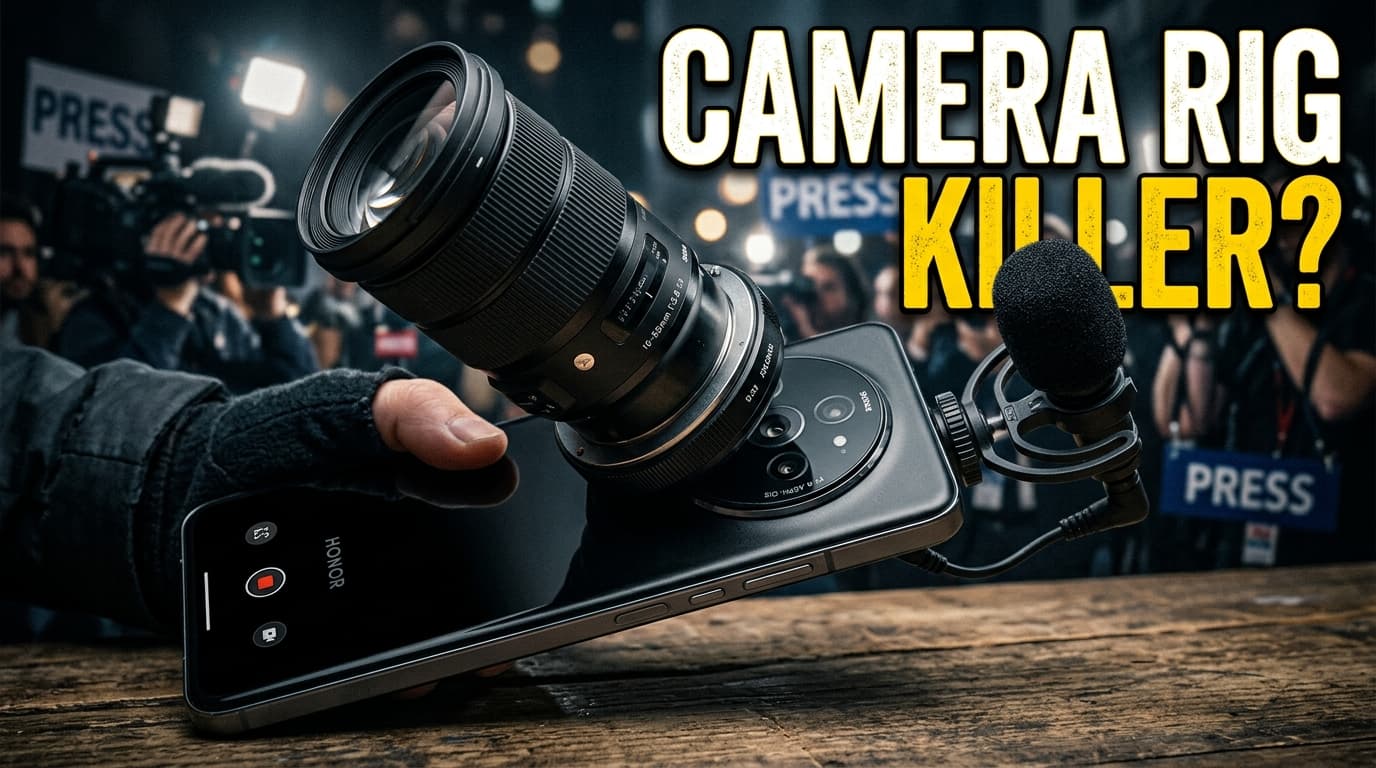
Honor wants creators to ditch their heavy mirrorless rigs, and its promotional campaign for the upcoming flagship device shows exactly how aggressive that ambition has become. By steadily spotlighting two hardware accessories designed specifically for documentary and film shoots, the brand is setting a radical tone for future hardware launches. Anyone planning to spend four figures on a camera phone this year needs to understand why these unusual attachments could completely reshape Android videography.
Key Takeaways
- Honor has initiated an aggressive teaser rollout for the Magic9 Pro Max, emphasizing an external optical teleconverter lens and studio-grade cinematic mic module.
- The modular teleconverter reportedly extends periscope optical reach beyond 10x without relying solely on aggressive computational upscaling or sensor crop.
- A customized multi-capsule directional microphone array mounts directly to the chassis, providing hardware-level wind cancellation and switchable acoustic pickup polar patterns.
- Targeting indie creators and mobile journalists, the accessories bypass third-party Bluetooth latency and clip-on smartphone rig clamps.
- Pricing and global retail availability remain unconfirmed, but industry analysts anticipate an official announcement ahead of the next major tech trade cycle.
The Physics Behind Honor's Optical Teleconverter
Smartphone telephoto sensors routinely run into physical limitations dictated by device thickness. While folded periscope optics have allowed vendors to pack 5x and 10x focal equivalents into 8.5mm camera bumps, glass quality and aperture speeds inevitably degrade as focal lengths climb. Honor's Magic9 Pro Max strategy tackles this constraint head-on by reintroducing external optical glass engineered specifically for the phone's native periscope module.
Rather than relying on universal screw-on lenses from accessory makers that often blur edges and cause severe chromatic aberration, this dedicated teleconverter features custom bayonet or magnetic alignment pins. These pins align the supplementary elements precisely with the primary telephoto optical axis. The setup communicates directly with the camera ISP, allowing the imaging software to map and counter optical distortion profiles in real time.
- True optical magnification that preserves light intake across an oversized 1/1.4-inch telephoto sensor.
- Integrated electronic communication pins that feed focal calibration data directly to the Snapdragon platform ISP.
- Nano-coated fluorite elements designed to combat glare, ghosting, and internal barrel reflections under direct sunlight.
- A mechanical mount that locks into a reinforced skeleton case, distributing stress away from the delicate camera island.
Early leaks suggest the attachment delivers a 2.0x multiplying factor. Combined with an internal 5x periscope mechanism, that gives the device a true 10x optical baseline equivalent to roughly 240mm on a full-frame sensor. Mobile wildlife photographers and sports shooters routinely complain about digital watercolor artifacts when cropping beyond 15x; pure glass fixes that problem at the physical level before sensor readout begins.
Solving the Weak Link: The Cinematic Mic Module
Video quality on flagship phones has outpaced integrated audio capture for years. Despite marketing claims about spatial audio and beamforming algorithms, tiny pinhole microphones placed near the charging port or camera bump pick up handling noise, chassis vibration, and wind buffeting. Honor addresses this headache by offering a hotshoe-style cinematic mic unit built specifically for run-and-gun documentarians.
The teaser materials showcase an elongated multi-capsule housing that snaps securely onto the device frame. Instead of transmitting audio over lossy Bluetooth with noticeable delay, this module establishes a direct hardwired connection through high-speed pogo pins located along the perimeter. This data pipeline ensures zero-latency monitoring through wired headphones while delivering uncompressed 24-bit/96kHz linear PCM audio capture directly into the video file container.
- Front Directional Shotgun: Focuses tight pickup on dialogue directly in front of the lens while rejecting 75 percent of off-axis street noise.
- Binaural Ambient Array: Captures immersive stereo room tone for nature documentaries and live music performances without artificial phase cancellation.
- Bi-Directional Interview Mode: Uses opposing diaphragms to capture crisp audio from both the subject in front of the lens and the interviewer standing behind the phone.
- Acoustic Wind Protection: Ships with a fitted micro-fur windshield (deadcat) that clips directly onto the housing, preventing diaphragm clipping during outdoor gusts up to 25 mph.
For solo content creators who often juggle separate lavalier transmitters, clip-on receivers, and external cold shoe brackets, having an integrated, bus-powered audio capture unit eliminates three failure points in a single stroke.
How the Magic9 Pro Max Challenges Traditional Mirrorless Rigs
For decades, camera manufacturers like Sony, Canon, and Panasonic felt secure knowing that professional workflows required dedicated bodies. Ergonomics, sustained heat dissipation, dual card slots, and specialized glass kept mirrorless cameras safe from smartphone encroachment. Honor is systematically picking apart those defensive moats by engineering an entire ecosystem around the Magic9 Pro Max.
Heat generation remains the primary enemy of sustained 4K and 8K recording on mobile devices. Standard glass-slab phones begin dropping frame rates or dimming their screens after fifteen minutes of continuous 4K 60fps ProRes recording in direct sunlight. Honor's promotional videos hint at passive thermal coupling between the phone frame and the modular accessory grip. By siphoning thermal energy away from the primary system board, the setup allows prolonged high-bitrate capture without thermal throttling.
Furthermore, Honor is integrating customized 10-bit Log color profiles developed alongside professional colorists. Instead of forcing videographers to accept over-sharpened, hyper-saturated default computational processing, the Magic9 Pro Max software pipeline enables clean flat profiles with standard LUT import functionality built right into the native camera application. When you pair clean flat color profiles with genuine external glass and uncompressed shotgun audio, the gap between a four-hundred-dollar smartphone kit and a three-thousand-dollar cinema package shrinks dramatically.
Ecosystem Compatibility: A High-Stakes Gamble
Modular smartphone accessories have a checkered history across the tech landscape. Enthusiasts remember the ambitious failures of the LG G5 Friends system and the eventual retirement of Motorola's Moto Mods. Consumers hate buying expensive peripherals that become obsolete the moment they upgrade their phone eighteen months later. Honor faces a skeptical audience that remembers those prior missteps.
To avoid repeating past industry blunders, Honor appears to be adopting an adaptable mounting architecture. Leaked schematics show that the cinematic mic and teleconverter mount via an intermediate protective cage rather than directly to the bare glass chassis. This means future devices in the Magic series could conceivably support the exact same accessories simply by releasing an updated ten-dollar cage tailored to the next chassis geometry.
If Honor can assure buyers that these high-end optical and acoustic modules will work across multiple hardware generations, the value proposition shifts completely. Videographers view good glass and professional microphones as long-term investments rather than disposable annual upgrades. If the company treats this ecosystem with the respect traditional camera brands afford their lens mounts, it could secure fierce brand loyalty among working creative professionals.
Summary
Honor is deliberately pushing the boundaries of smartphone hardware by teasing specialized external attachments instead of relying purely on artificial intelligence image synthesis. By pairing an optical teleconverter with a dedicated zero-latency cinematic mic array, the Magic9 Pro Max establishes itself as a serious tool for demanding videographers. If the company delivers durable build quality and backwards compatibility across future hardware cycles, this modular push could redefine flagship expectations.
FAQs
When will the Honor Magic9 Pro Max launch?
Honor has not confirmed a definitive retail release date, though industry rollout schedules point toward an official launch in the first quarter of the year. Western market availability typically follows initial domestic availability by several weeks.
Can I use the teleconverter lens on other smartphone models?
No, the optical elements and electronic communication protocols are custom-tailored to the specific sensor dimension and periscope arrangement of the Magic9 Pro Max. Using it on unaligned hardware would introduce severe optical distortions.
Does the cinematic mic require a separate battery?
The teaser materials indicate the microphone draws low-voltage power directly from the smartphone chassis using integrated physical contact pins, eliminating the need for independent battery charging or wireless pairing steps.
Will the Magic9 Pro Max support professional video formats?
Yes, Honor plans full integration for 10-bit Log capture, custom LUT previews, and uncompressed multi-channel linear PCM audio recording directly inside the primary camera software interface.