
The White House Just Ordered Federal Agencies to Stop Saying 'AI'
A new executive order mandates that federal agencies use 'Super Intelligence' instead of 'AI' in official documents, accompanied by a voluntary frontier model pact.
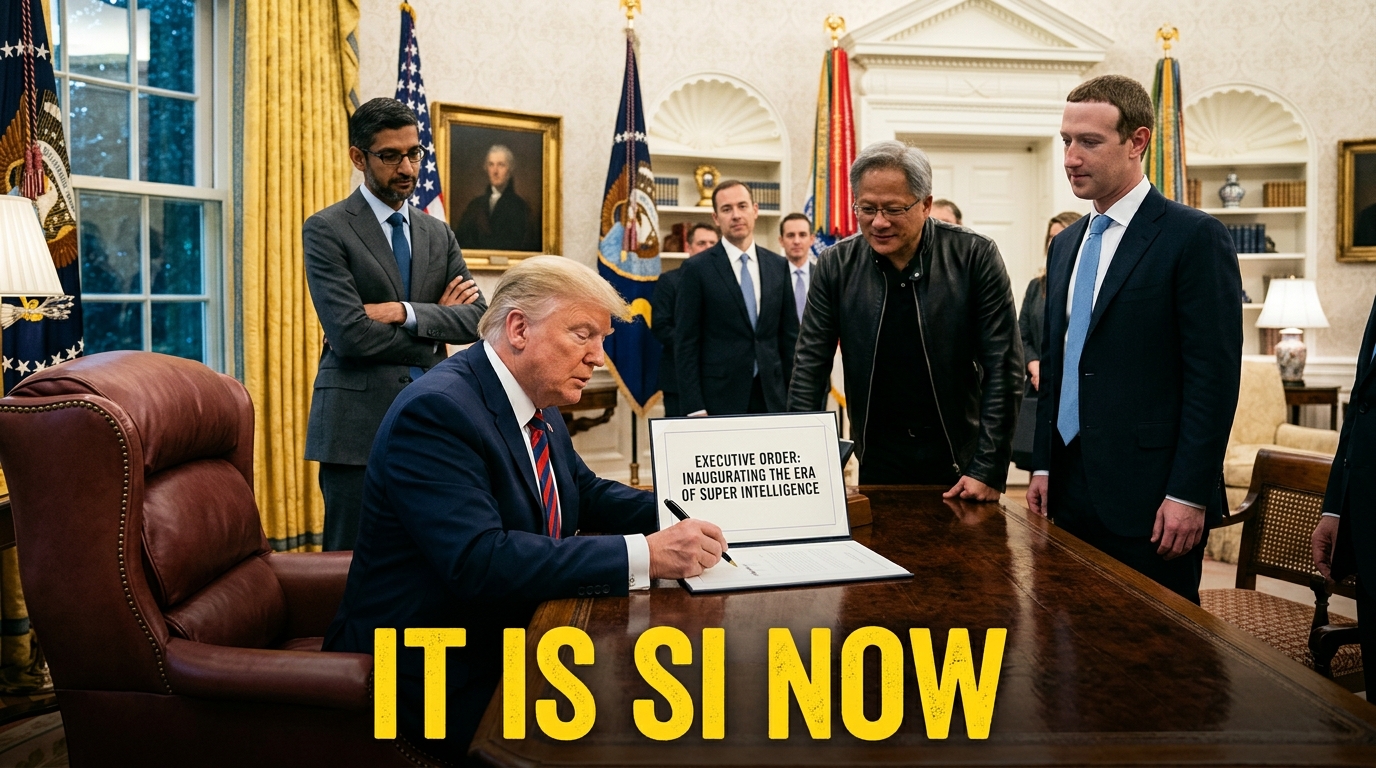
On September 29, 2026, President Donald Trump signed an executive order titled "Inaugurating The Era of Super Intelligence," mandating executive branch departments and agencies to use "Super Intelligence" and "SI" instead of "Artificial Intelligence" and "AI" in official correspondence, public communications, policy documents, and websites.
"From this point forward, all of United States documents and hopefully the world's, will be changed to use the much more accurate term Super as opposed to Artificial," Trump said. "So it's Super Intelligence."
Scope of the Executive Order
The directive instructs federal agencies to no longer acknowledge the terms "Artificial Intelligence" or "AI" in applicable non-statutory official documents. It explicitly excludes previously issued regulations, presidential actions, contracts, grants, and historical government records from mandatory modification.
Statutory law remains unchanged for now. The order gives the Assistant to the President for Science and Technology 60 days—until November 28, 2026—to submit a proposed federal statutory definition of "Super Intelligence" and evaluate how it interacts with existing statutory definitions of AI. Whether Congress will adopt or codify that terminology remains uncertain.
The Voluntary Accord and Industry Signers
Alongside the order, Trump and leaders from six technology companies signed the "White House Accord on Super Intelligence: Joint Commitment on Frontier Responsibilities." The 308-word document outlines a voluntary, four-layer framework covering frontier model safety practices and audits. The official signature line included a clerical error, misspelling Trump's office title as "President of the Unites States."
The accord was signed by Dario Amodei (Anthropic), Greg Brockman (OpenAI), Jensen Huang (Nvidia), Elon Musk (xAI), Sundar Pichai (Google), and Mark Zuckerberg (Meta). Participation across tech giants remained divided. Amazon founder Jeff Bezos and Microsoft CEO Satya Nadella attended the White House luncheon on September 29 but did not sign the accord. Apple did not participate in the summit.
Trump described the accord as a "morally binding" pact operating "almost like a constitution." However, legal analysts and industry watchdogs noted that the voluntary agreement carries no statutory authority or external legal enforcement mechanisms.
International Claims and Domain Speculation
A White House fact sheet claimed that Trump and Chinese President Xi Jinping agreed during a bilateral state visit to replace the term "artificial intelligence" with "super intelligence," though foreign governments and international governing bodies have not adopted the phrasing.
The policy announcement also triggered rapid speculation around Slovenia's country-code top-level domain (.si). Slovenian registry Register.si reported registrations jumped to over 44,000 in September 2026 from fewer than 2,000 in August, including 11,000 registrations recorded on September 30 alone. Web registrar Hostinger reported that more than half of its new .si domain purchasers originated from the United States and India.
Regarding the federal push to reshape language, Trump remarked: "Let's see if I have any power. Maybe I do and maybe I don't. We're gonna find out pretty soon."